

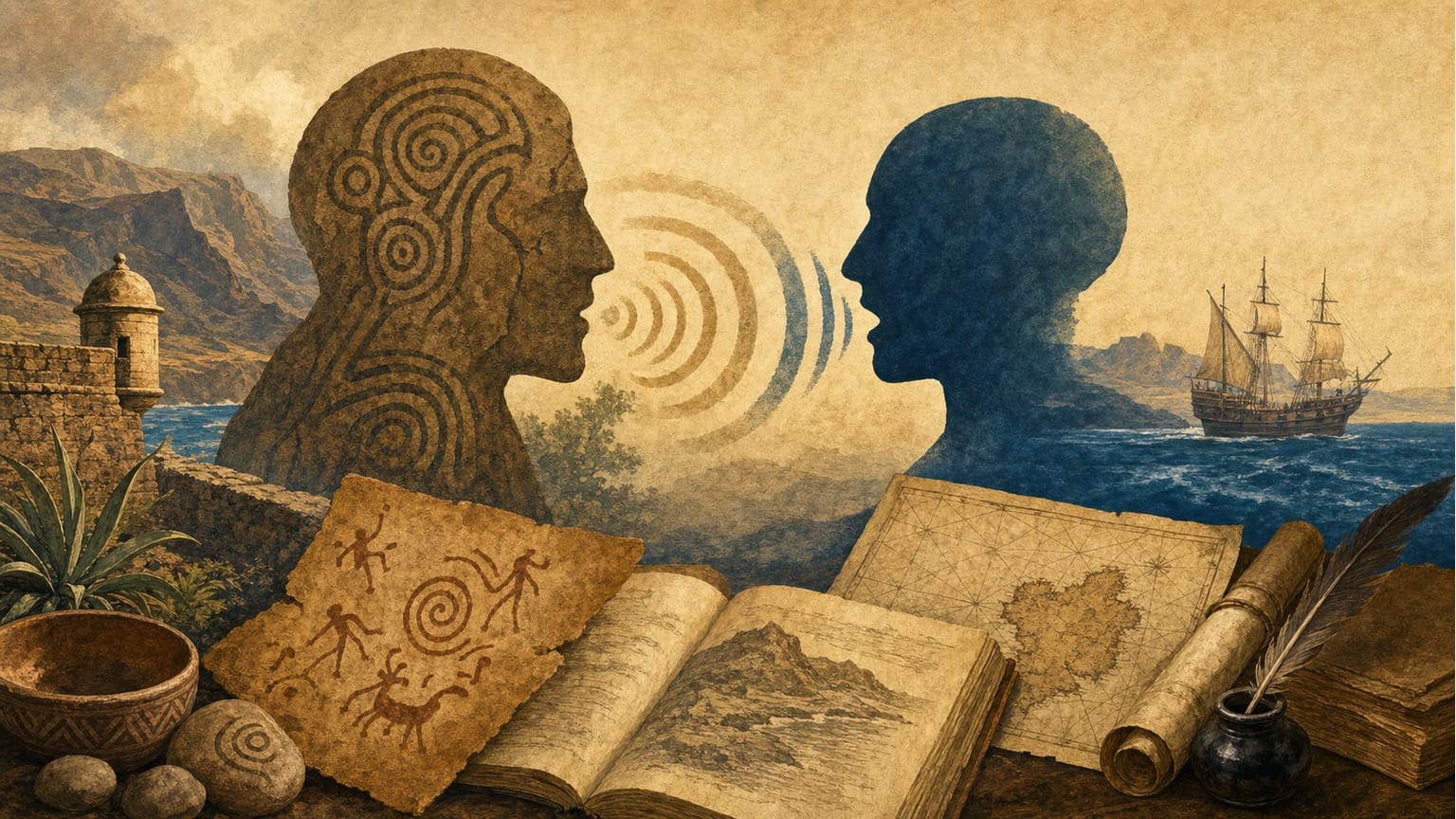
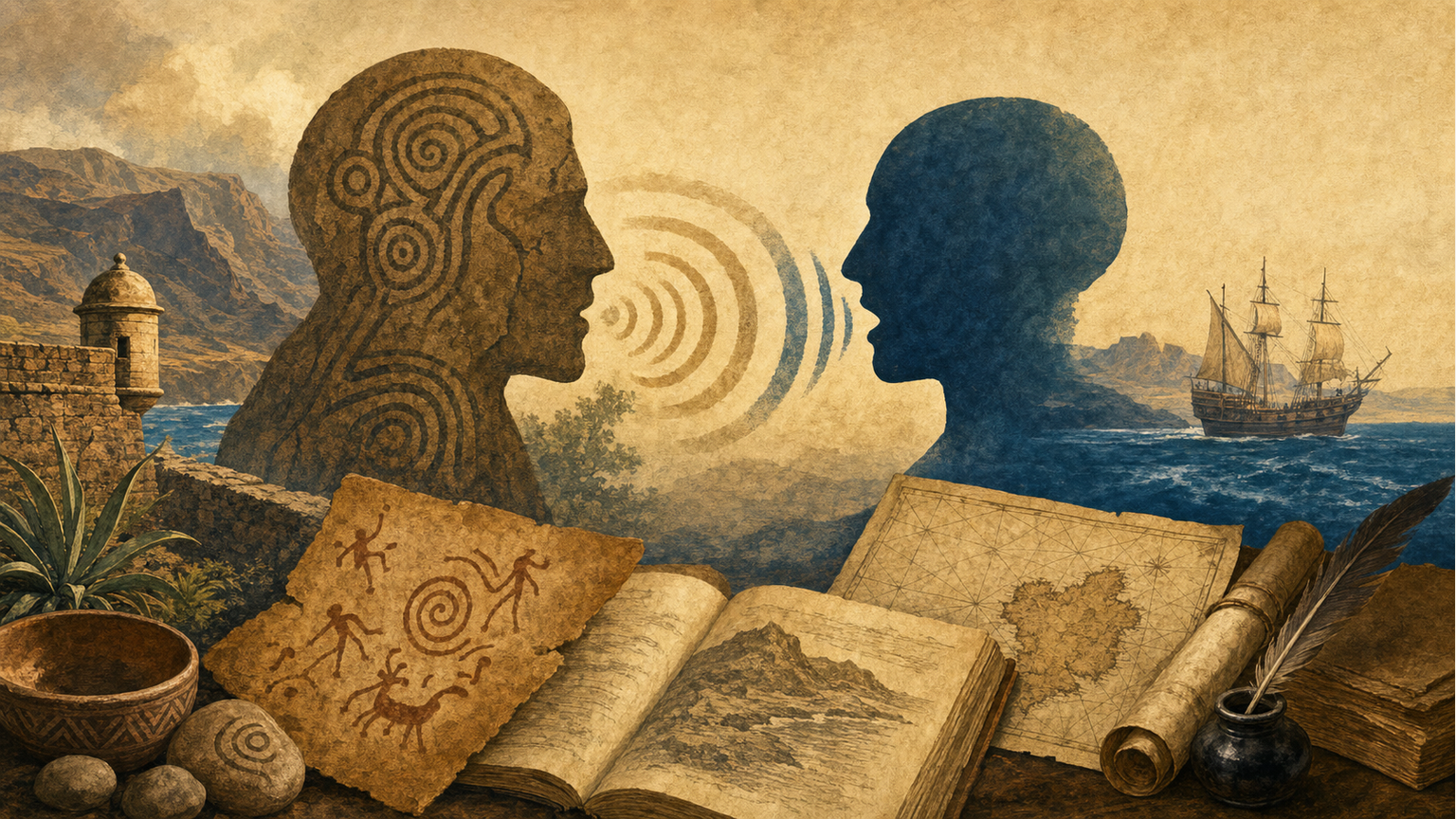
In his work “Estudios sobre el guanche”, Maximiano Trapero highlights the importance of orality as a primary source for studying the language of the ancient inhabitants of the Canary Islands, in contrast to the traditional reliance on written sources[1]. Trapero notes that most previous studies on the Guanche language have been based almost exclusively on documentation found in early historical and documentary sources from the time of conquest and colonization[1].
According to Trapero, the Guanche language was lost quickly, probably within two or three generations after the conquest of each island. He regrets that no conqueror, chronicler, monk, or missionary at the time took the initiative to collect or describe the language, or to create a grammar or dictionary, as happened later in the Americas[1]. As a result, what has reached us are isolated lexical elements, gathered in a fragmentary way in written texts, rarely exceeding the level of single words[1].
Trapero, however, points out that there is another, more complete and reliable source: orality. He argues that orality has been systematically ignored or undervalued in Guanche studies, even though it represents a natural and living transmission of linguistic elements[1]. This neglect is partly due to the fact that many Guanche scholars have been foreigners, unfamiliar with Spanish and Canarian reality, and have conducted their research “at a distance,” relying on previous lists and repertoires without verifying their accuracy or conducting fieldwork[1].
Trapero argues that although the Guanche elements transmitted orally have been “Spanishized” and must be understood from that perspective, orality is more faithful to linguistic identity than writing. Oral transmission ensures natural continuity, while writing involves a double transformation: first, changing the signifier from one language to another, and then transliterating a sound sequence into written form[1].
The author acknowledges that orality has not been completely ignored, citing the example of Juan Bethencourt Alfonso, who in the late 19th century collected oral materials in Tenerife when tradition was still a nearly unchanging way of life[1]. Nevertheless, Trapero insists that orality should take priority in linguistic and toponymic research in the Canary Islands, as it allows access to forms and meanings that written documentation cannot offer with the same authenticity[1].
In conclusion, Trapero proposes that orality should be the current criterion for representing forms that are uncertain due to differing written records, arguing that expressions preserved in oral tradition deserve greater respect and attention in studies of the Guanche language[1].