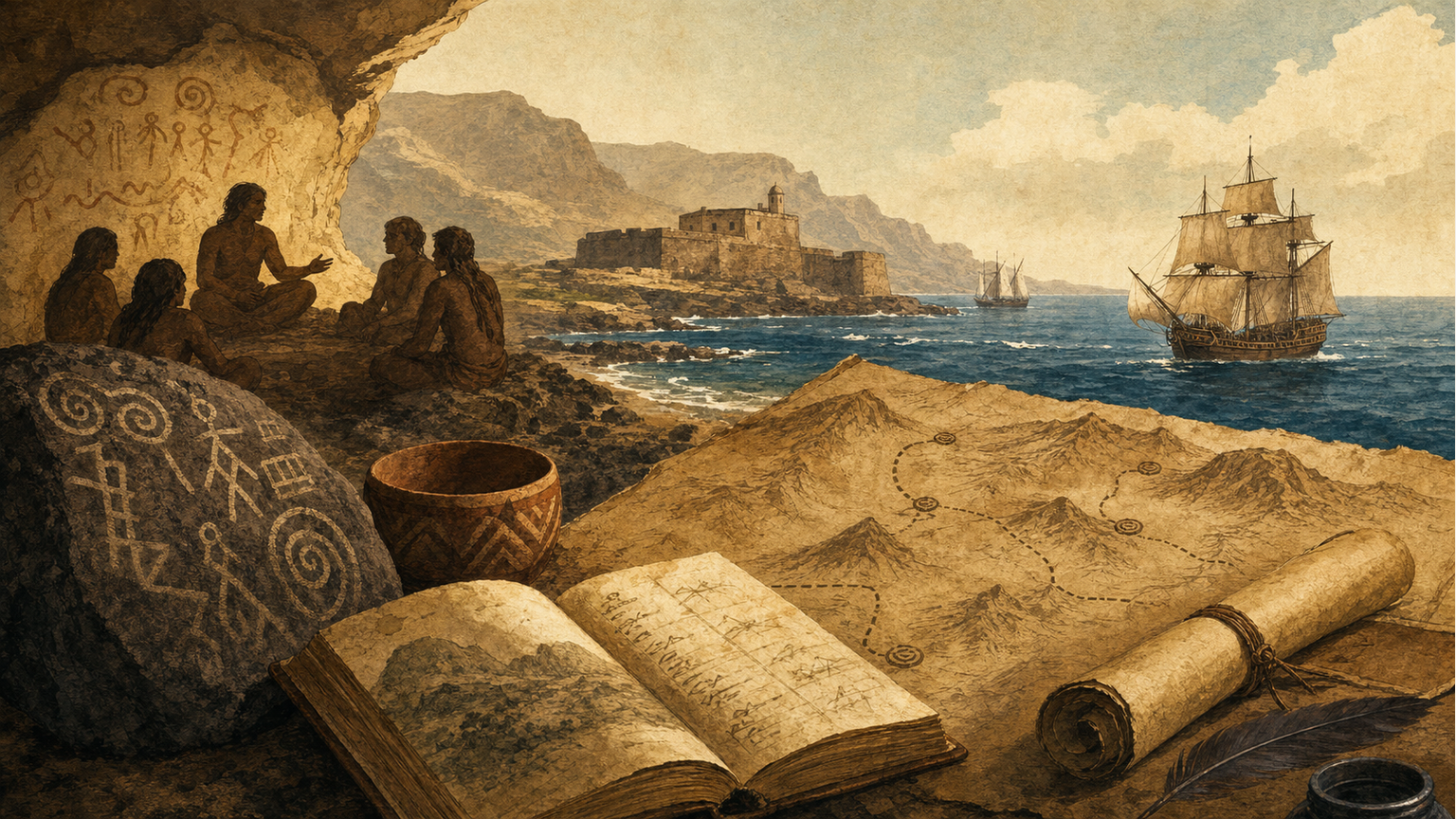

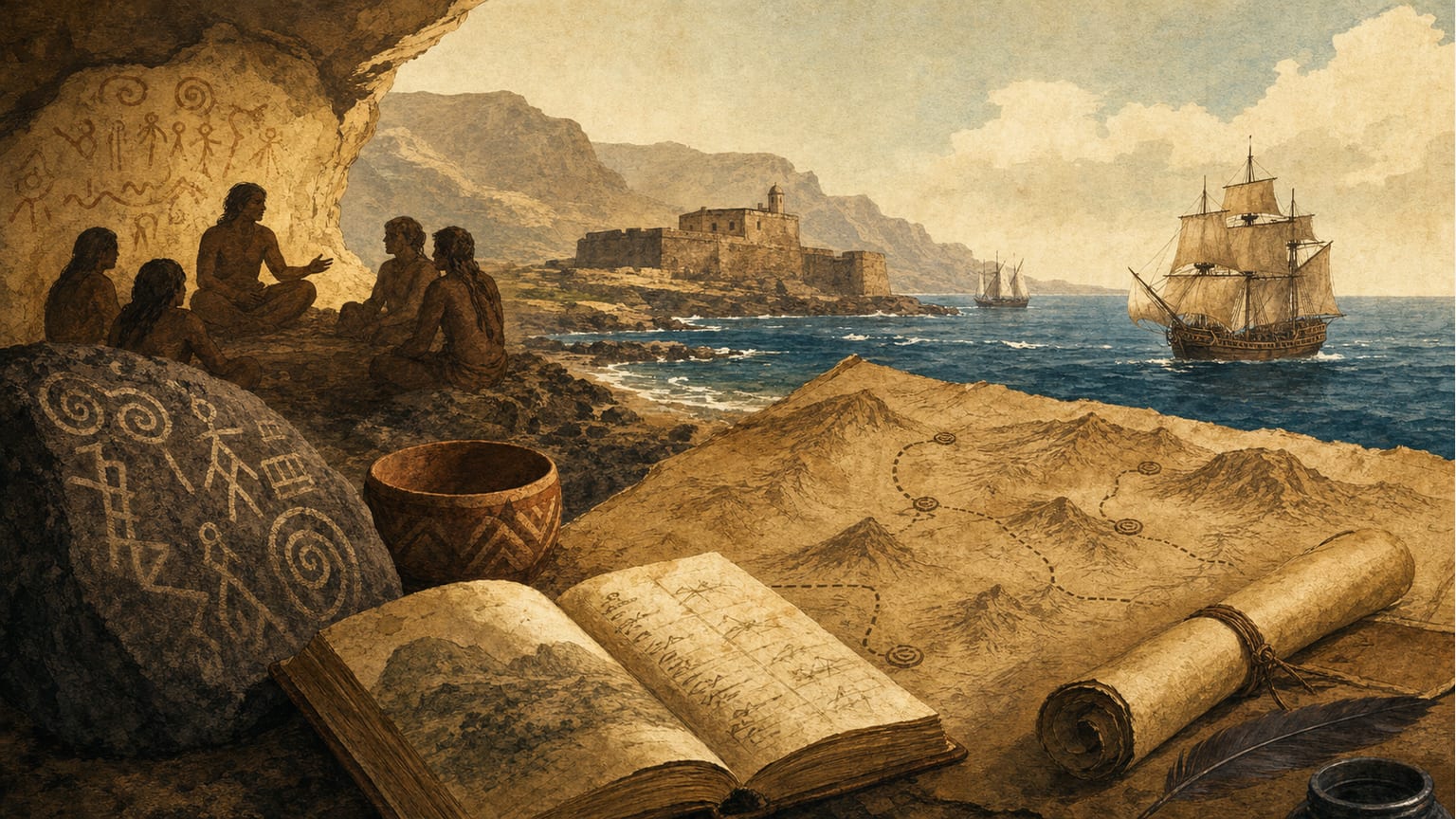

Maximiano Trapero’s research emphasizes the crucial role of oral tradition in preserving and studying Guanche toponymy in the Canary Islands. The author notes that, although the language of the ancient Canarians disappeared quickly after the conquest, oral transmission has allowed many indigenous names and terms to survive, despite the absence of systematic written documentation during the colonial period [1].
Trapero points out that most previous studies on the Guanche language have relied almost exclusively on documentary and historiographical sources from the early period of conquest and colonization. However, he warns that these documents have significant limitations, as the chroniclers and scribes of the time were not linguists and often copied and recopied terms without rigorous verification or fidelity to the original pronunciation [1].
The author stresses that oral transmission has been systematically ignored or undervalued by many researchers, even though it constitutes a more complete and reliable source for studying Guanche vocabulary. According to Trapero, “oral transmission is always more faithful to linguistic identity than writing, since writing implies a double transformation: first, changing the signifier from one language to another, and then transliterating a sound sequence into an orthographic segment” [1].
A concrete example provided by the author is the place name “Guarazoca” in El Hierro. Trapero explains that, although the most common written form is “Guarazoca,” the living pronunciation on the island is “Guarasoca.” This difference highlights the relevance of orality as a criterion for the current representation of Guanche names, as opposed to a superstitious respect for the old printed word [1].
In Trapero’s view, orality should take precedence in the study of Canarian and Guanche toponymy, as it reflects the genuine expression of the language and allows for the correction of errors or variants introduced by written transmission. The author argues that oral tradition, although “Spanishized” over time, preserves essential elements of the indigenous language that are not found in written texts [1].
Finally, Trapero proposes that orality should be the main criterion for representing Guanche place names today, especially in cases where there are doubts or graphic variants. This position, although it may seem surprising from a visual perspective, responds to the need to preserve the linguistic and cultural authenticity of the indigenous names of the Canary Islands [1].