

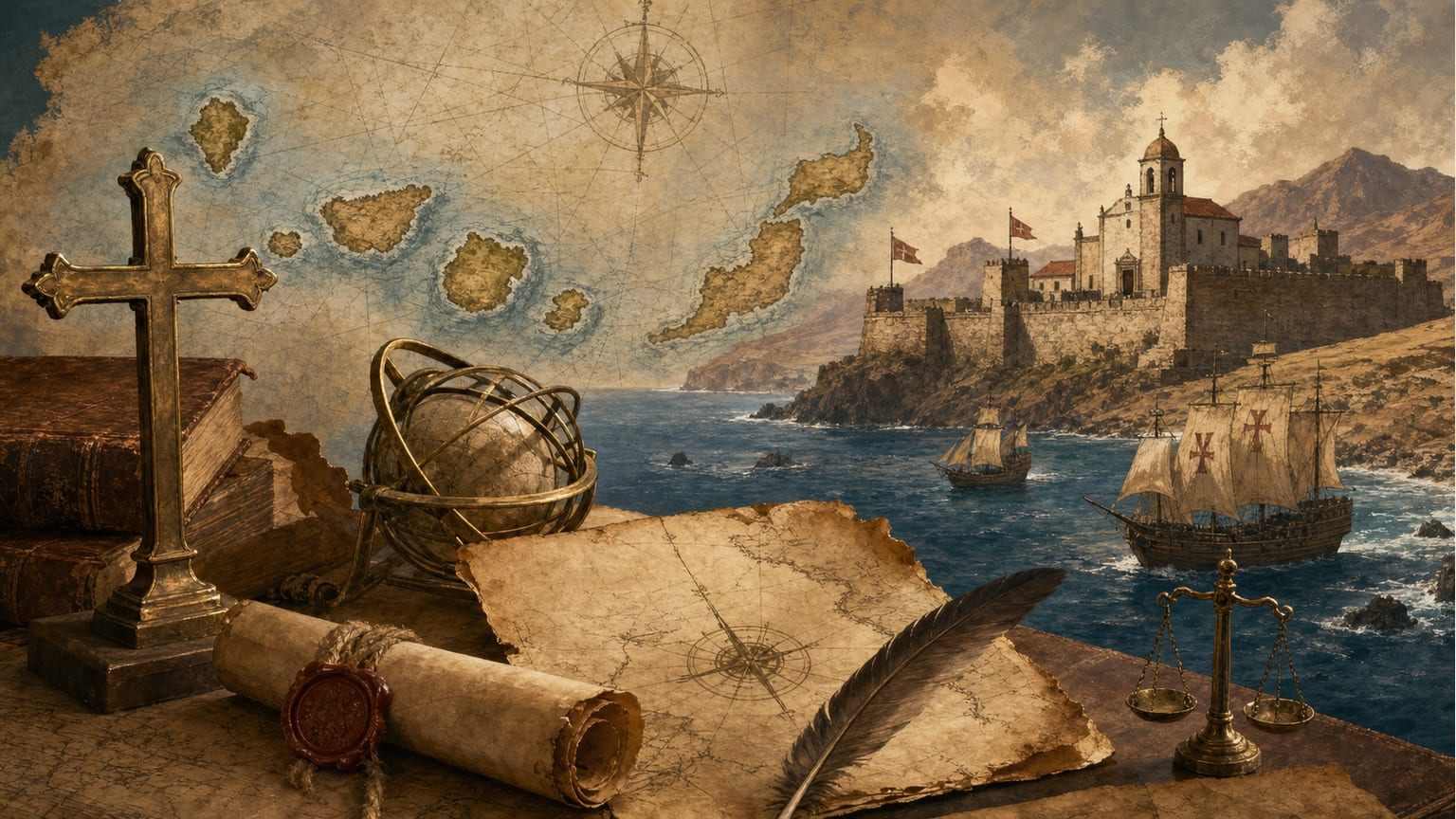
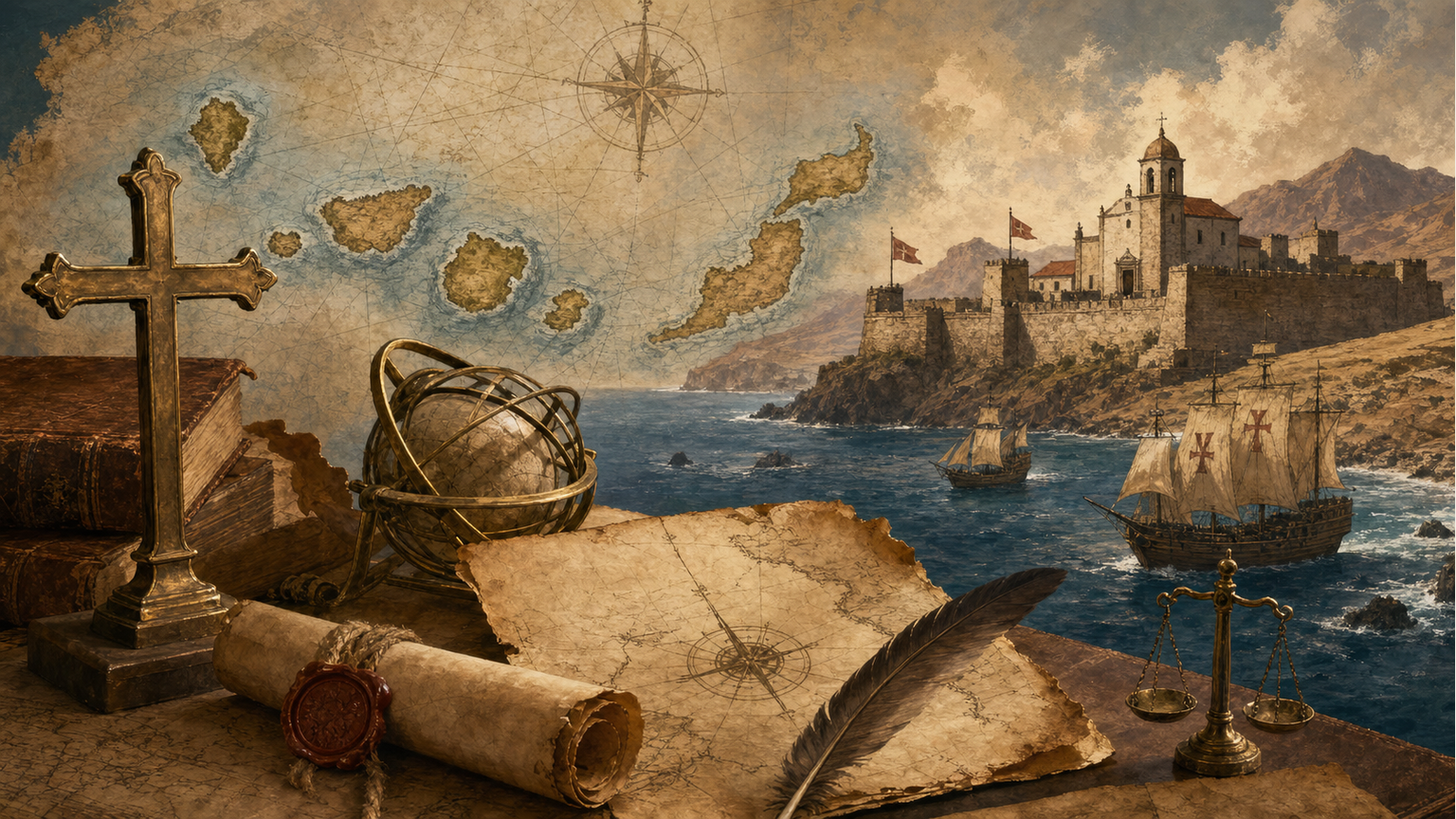
During the conquest of the Canary Islands, the Church played a fundamental role in legitimizing and organizing the process of incorporating the archipelago into the European sphere. The Diocese of Canariensis and Rubiconensis was the first major diocese in the Atlantic, foreshadowing the model later applied in the Americas[1]. The first significant papal donation was made by Clement VI to Luis de la Cerda in 1344, granting him the title of Prince of Fortune. This act was politically motivated, as the Pope, weakened by the schism, sought to reaffirm his power by creating a fief of the Holy See in the islands[1].
The Church’s intervention was not limited to evangelization; it also served as an ideological shield to justify the expansionist interests of European powers. According to Peter Russel, papal doctrine held that only Christian society was legitimate, and the Pope had the right to dispose of the territories of pagan princes and peoples who refused conversion[1]. However, there was also the idea of a legitimate human society that included all humans, Christian or not, over which the Pope had no power[1].
The process of conquest and colonization of the Canary Islands was a laboratory for the transformation of European feudal law into international law. Antonio Pérez Voituriez notes that, from the early homage lawsuits to the Treaties of Alcaçovas and Tordesillas, there was a transition from European public law to international law aimed at imposing itself in Africa and America[1]. Alonso de Cartagena, a defender of Castilian interests, laid the foundations of classical international law for African colonization by separating the right of occupation from the value of papal donation, distinguishing between evangelization and rights of conquest[1].
The Treaties of Alcaçovas (1479) and Tordesillas (1494) consolidated the Canary Islands’ strategic position in the Atlantic. The former placed the islands at the frontier between Castilian and Portuguese interests, while the latter made them a platform for communications and trade with the New World[1].
The arrival of missionaries, merchants, and slave traders in the Canary Islands generated debates about the legitimacy of enslaving the indigenous population. The Church and the Crown defended the freedom of the Canarians, considering them “pagans in the process of Christianization”[1]. This debate anticipated the discussions that would take place a century later in Spain regarding the rights of the Crown in the Indies.
In conclusion, the conquest of the Canary Islands was not only a military and economic enterprise but also a process deeply influenced by the Church and the evolution of international law, factors that determined its integration into European Atlantic expansion[1].