

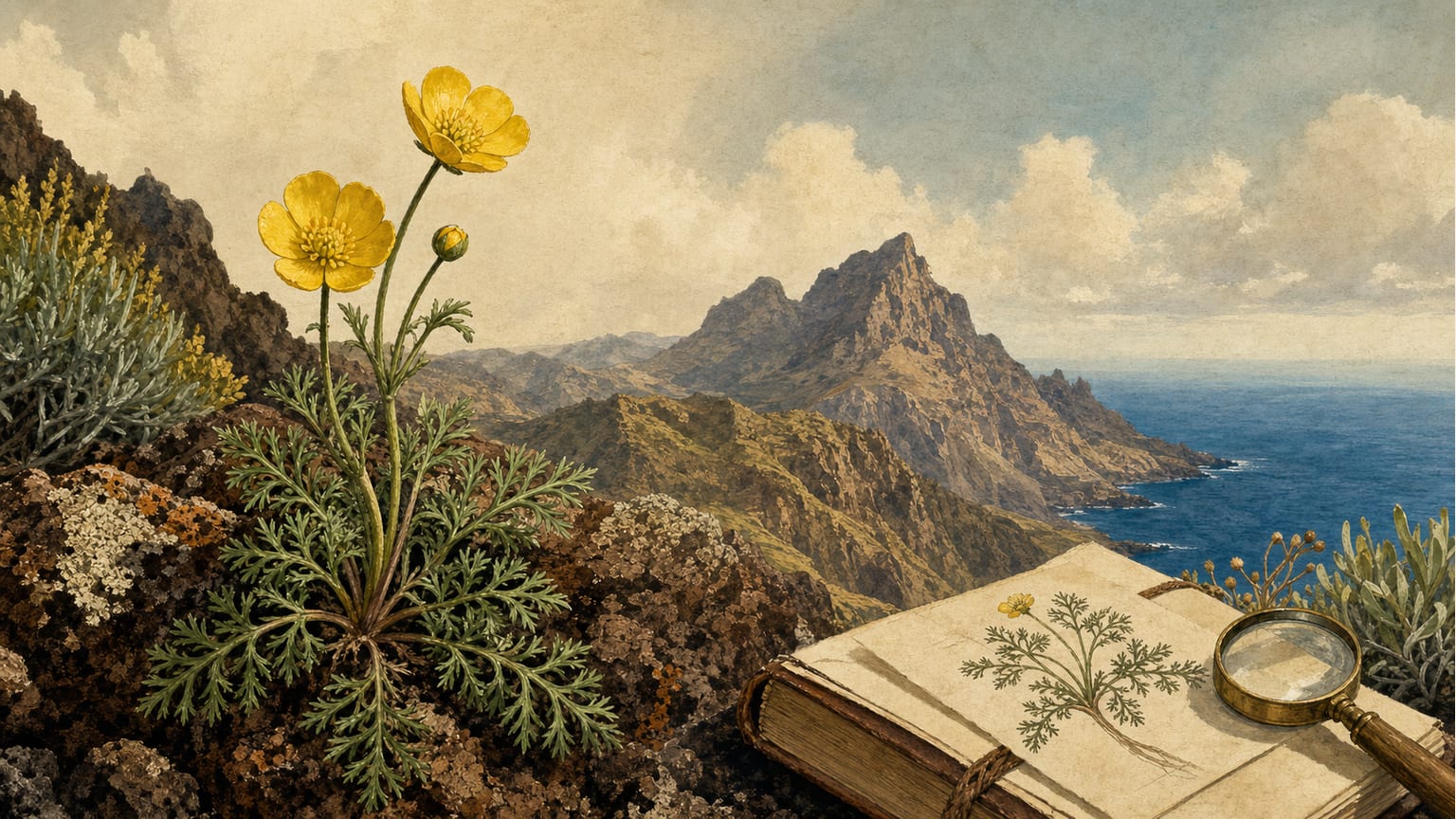
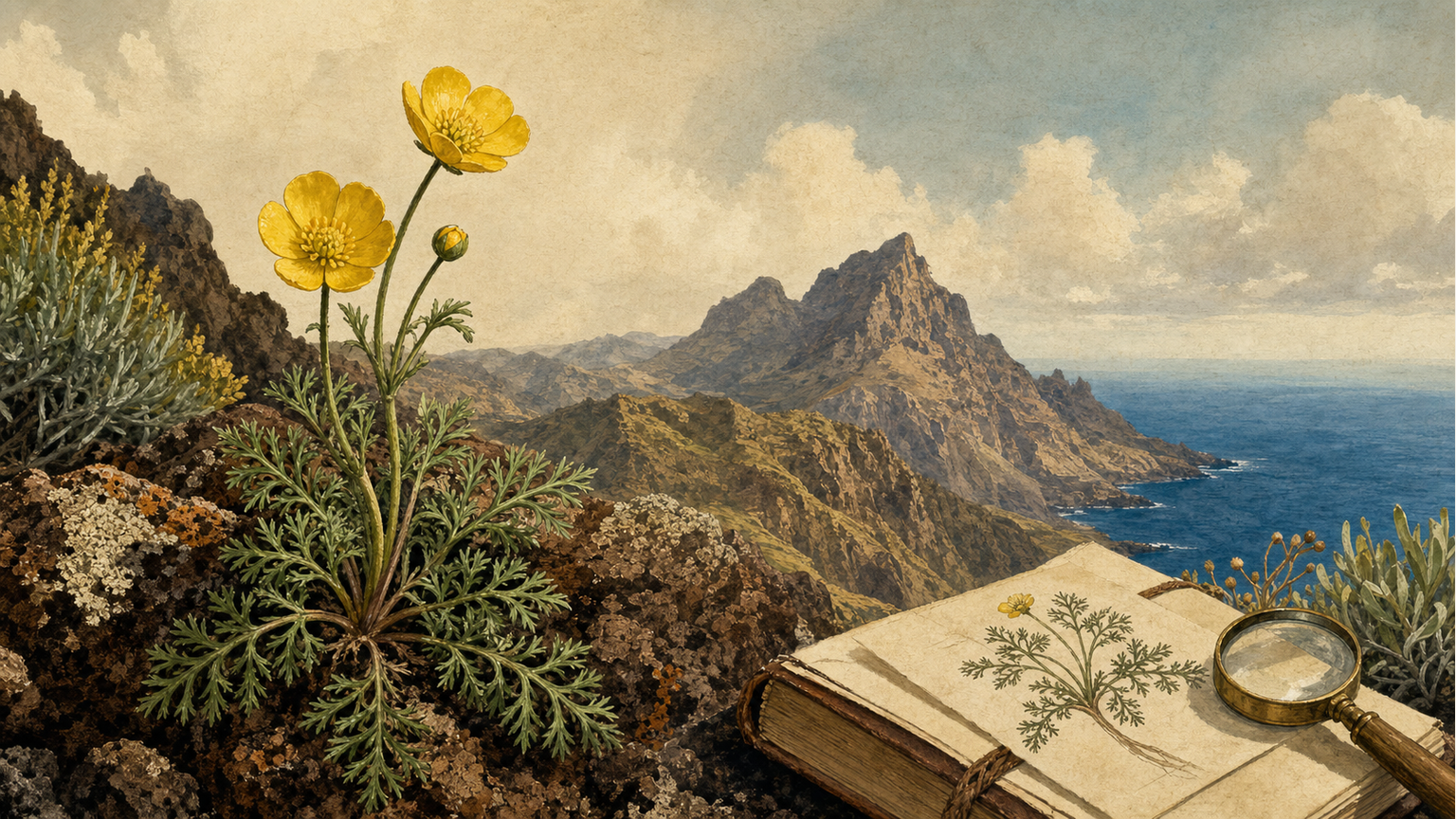
Ranunculus cortusæfolius is highlighted by Webb and Berthelot in their work “Histoire naturelle des îles Canaries” (1836-1850) as a distinctive species of the Canary Islands flora [1]. The authors identify this species as characteristic of Tenerife, Gran Canaria, and La Palma, where it is found primarily in rocky and forested areas of the wild regions [1].
The morphological description provided is detailed: the entire plant is covered with hairs, which are bulbous and translucent under the microscope. The rhizome is lumpy, and the roots are densely tomentose. The stem varies from a foot to four inches in height, always with spreading hairs [1]. The radical leaves are dark green, with scattered black spots, orbicular-reniform and cordate, with five sharply lobed margins. The upper leaves are tripartite or lanceolate, almost sessile, and barely clasp the stem [1].
The petioles are hairy, and the sheaths of the radical leaves are dilated and ciliate at the top. The sepals are lanceolate and hairy, while the petals are large, intensely yellow above and paler below, with impressed lines [1]. The stamens are longer than the ovaries, and the style is nearly straight or slightly curved. The fruits form a cylindrical spike up to six inches long, with compressed, hispid, brown achenes [1].
The main variety of R. cortusæfolius is found in grassy rocks of the forested regions of Tenerife, Gran Canaria, and La Palma. It is especially abundant in the western hills of Tenerife, near Buena Vista, El Palmar, Los Silos, and around La Orotava. Another variety, called “B,” grows under laurel shade and in moist, treeless interior forest areas, such as the Mercedes forest and other locations in Tenerife and Gran Canaria [1].
According to Webb and Berthelot, the species is endemic to the Canary Islands, although they note that variety “B” has spread to Madeira, where it was collected by botanist Lowe in 1828 at Ribeiro Frio [1]. The authors emphasize that the Canarian plant is easily distinguishable from other European species, such as R. creticus, by its morphological features, especially the pilosity of the stems and leaves, the shape of the lobes, and the structure of the fruits [1].
Webb and Berthelot also point out that the Canarian variety has larger leaves and stiffer hairs, with radical leaves barely lobed or cordate and a stem that can exceed three feet in height. The flowers are large, with petals often an inch long [1]. The fruit spike is shorter, denser, and wider, and the achenes have a curved mucro. Under the microscope, the hairs of R. cortusæfolius are bulbous and translucent, unlike those of R. creticus, which are opaque and denticulate [1].
In terms of geographic distribution, Webb and Berthelot state that Ranunculus cortusæfolius is a species native to the Canary Islands, with only one variety present in Madeira. No presence is documented outside the archipelago and Madeira at the time of publication [1].
The work of Webb and Berthelot thus provides a fundamental reference for the study of Canarian endemic flora, highlighting the uniqueness and botanical richness of the islands in the context of the 19th century [1].