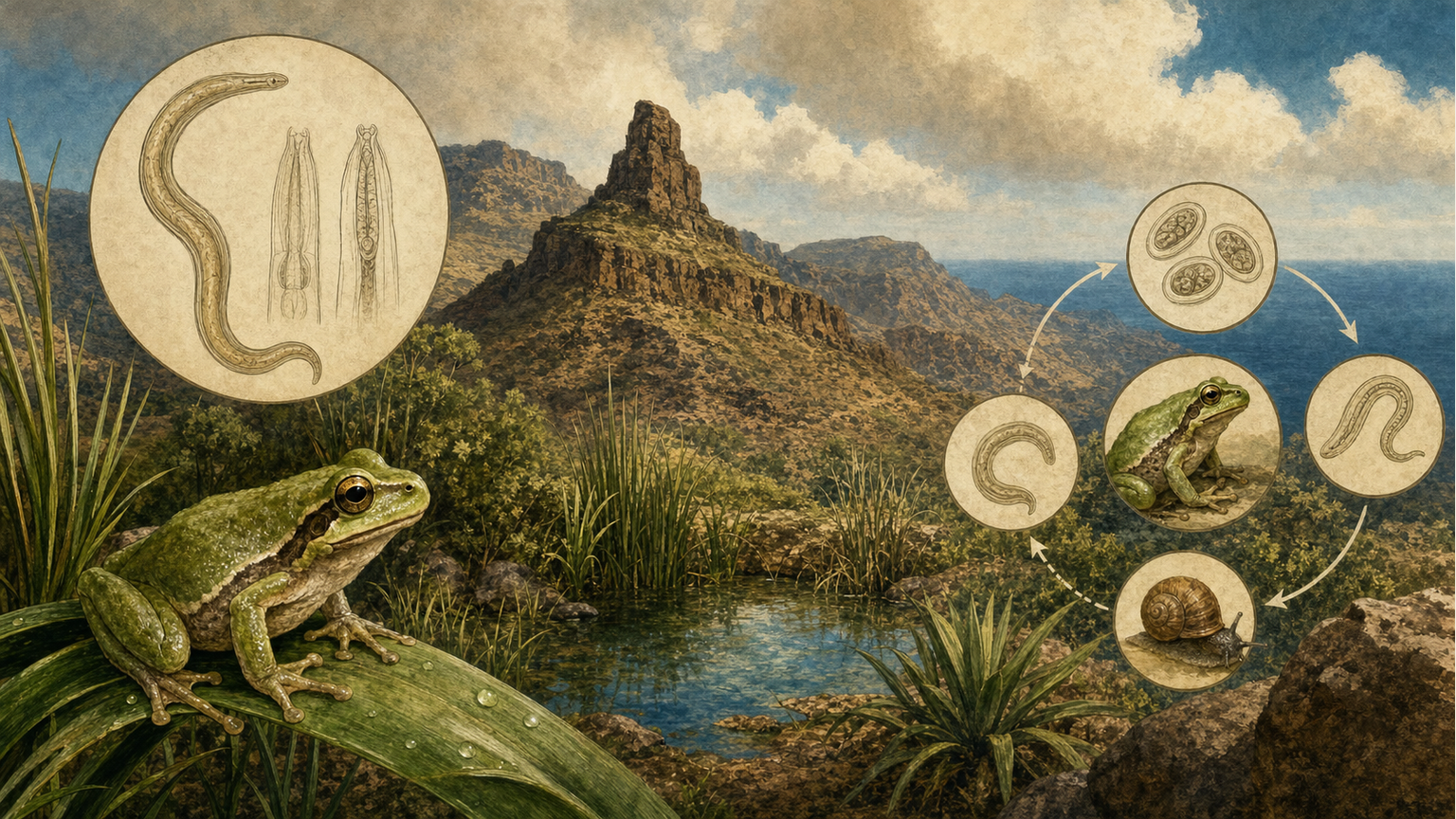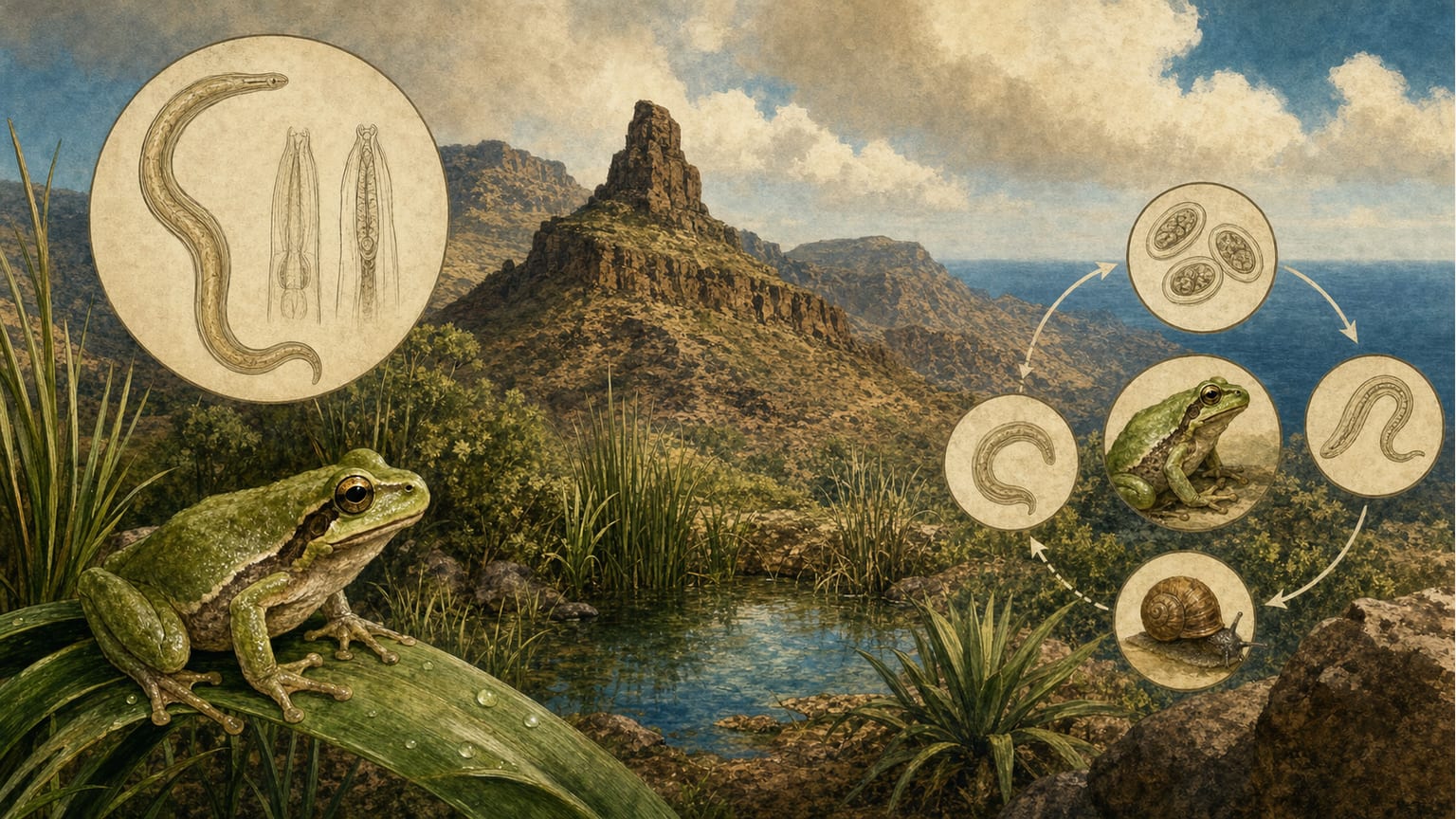

In his 1943 study, Gonzalo Pérez Casanova documented the discovery of a new species of strongylid parasite in specimens of Hyla meridionalis (a frog commonly found in the lowland and coastal areas of Gran Canaria, especially in banana plantations and irrigation ponds) [1].
According to the author, this nematode parasite has a life cycle that includes larval and adult stages, although at the time of the study, the nymphal stage had not been clarified, which was expected to be identified due to the specific habitat [1]. The parasite’s eggs are ellipsoidal, measuring approximately 160 by 110 microns, and when expelled, already contain an embryo in an advanced stage of development. The capsule is thick and lacks surface reliefs, and at hatching, one pole opens as an operculum [1].
Pérez Casanova describes observing the hatching of the eggs by incubating them and separating them from the host’s feces using a concentrated sodium chloride solution. The embryo takes about eight days to develop, and twenty-four hours before hatching, the rhabditiform larva begins movements that allow it to break the operculum and exit the egg. Upon emergence, the larva measures approximately 900 microns in length and 45 in diameter, with a cylindrical body, well-defined buccal opening, and a sharp caudal region [1].
Regarding adults, Pérez Casanova notes marked sexual dimorphism: females have a pointed posterior end, while males have a truncated one and are smaller (females 16-18 mm, males 9-10 mm). The body is whitish or slightly pinkish, without appendages, with papillae around the mouth and, in males, a membranous copulatory pouch supported by four ribs, characteristic of the strongylid group [1].
The male genital apparatus consists of a single tube opening into the cloaca, which is surrounded by the umbrella-shaped copulatory pouch with two lobes, supported by four rays, two of which are trifurcated. The male also has two slightly unequal spicules. The female genital apparatus is also a differentiated tube, divided into two fertile parts located before and after the vulvar opening, and a double uterus is easily observed in most adults [1].
The mouth is central, circular, surrounded by six papillae, and leads to a muscular pharyngeal region. The entire anterior region of the body is externally surrounded by a sheath or collar, probably chitinous [1].
Finally, after comparing with other species of the genus Strongylus, Pérez Casanova concludes that the species found does not match those previously described and proposes to name it Strongylus Galdosianas, sending specimens to international specialists for evaluation [1].