

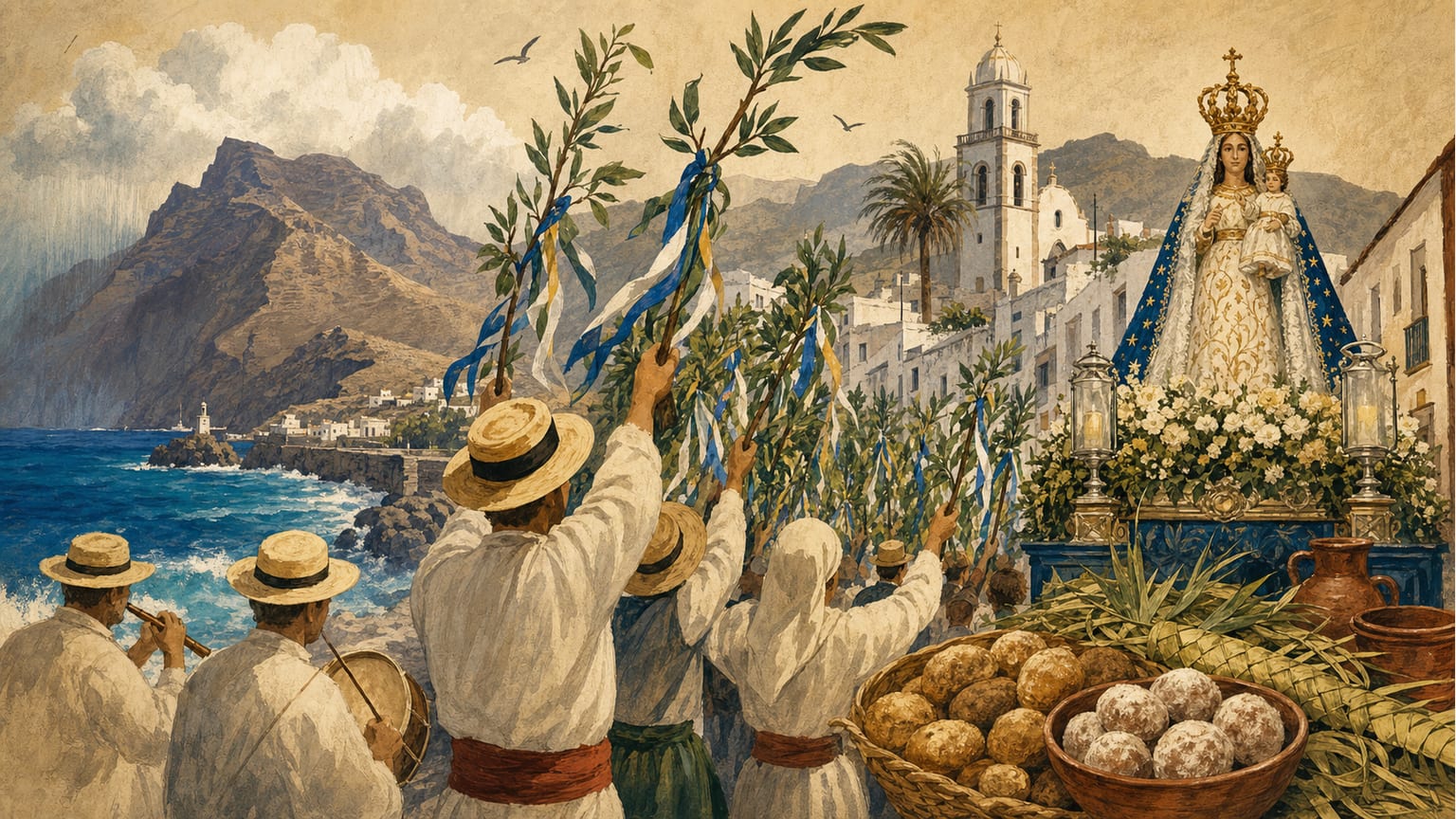
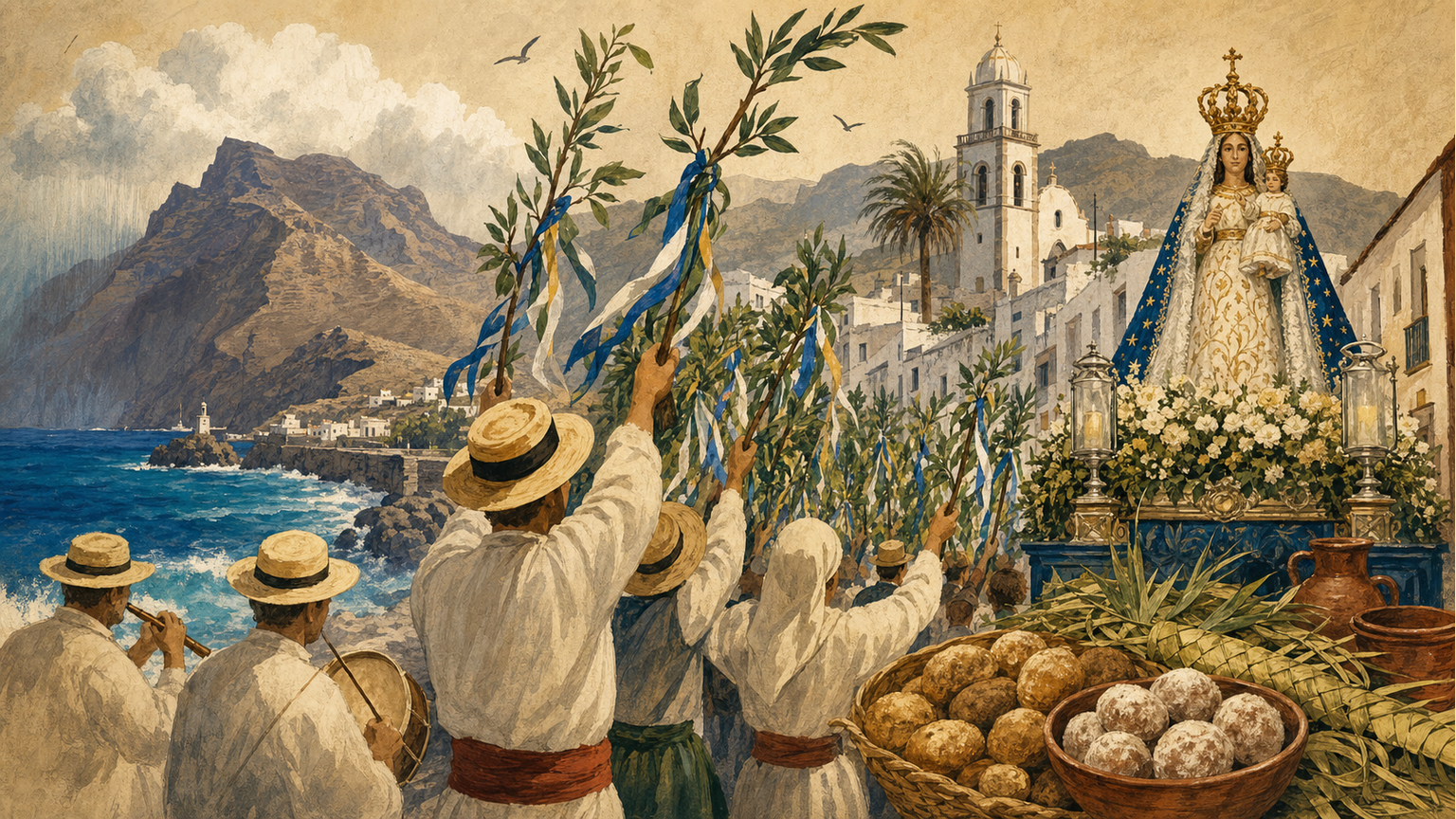
Every 4 August, something happens in Agaete, in north-west Gran Canaria, that makes little sense to the modern mind: thousands of people take to the streets carrying branches of pine, heath or laurel and dance without stopping for hours until they reach the sea. They call it the Bajada de La Rama, and it is —by far— one of the oldest and liveliest festivals in the entire archipelago.
An origin that is not as clear as it seems
The most frequently repeated version —the one found in almost any tourist brochure— says that the ancient Canarians came down from the mountain of Tirma and the pine forests of Tamadaba carrying branches, struck the sea with them and chanted to ask the gods for rain in years of drought.[1][2] It is a beautiful image, and it may contain some truth. But honesty is important: historians still debate the exact origin of La Rama. The oldest surviving press reports, from 1867, make no mention of a pre-Hispanic rite —they speak only of bringing branches to decorate the town for its patronal festivities, a custom that also existed in other municipalities far from the sea. The connection with an Indigenous rainmaking rite became popular mainly from the 1970s onwards. Whatever its true origin, the festival now acts as a bridge between two worlds: Indigenous imagery and Christian devotion, fused until they are impossible to distinguish.
From rite to devotion
With the arrival of Christianity, the custom did not disappear —it changed, as traditions often do when people are unwilling to let them go altogether. The offering of branches merged with devotion to Our Lady of the Snows, the patron saint of Agaete, and today devotees carry the branches to the sanctuary as a tribute before the main feast.[1] Water is still present, though now symbolically: some people still approach the sea and strike it with a branch, repeating the ancient gesture, although no one is now praying to a pre-Hispanic god.
The big day
The day begins early and in full force. At five in the morning, La Diana opens the festivities from the Town Hall: a rocket tears through the still-dark sky, the bands strike up and the whole town begins to dance before the sun has even risen.[1] Hours later comes the great moment —thousands of people moving through the town, waving branches to the rhythm of the bands and led by the papahuevos, the giant-headed figures representing beloved local characters— until they inevitably reach the sea.[1]
The festival has been designated a Festival of National Tourist Interest since 1972,[1] but no one in Agaete needs that distinction to understand what it means. Remarkably, the festival has not lost its original purpose, even in the small print: deep down, it remains a way of asking nature for something essential, although today the gesture is dressed in dance and religious fervour.