

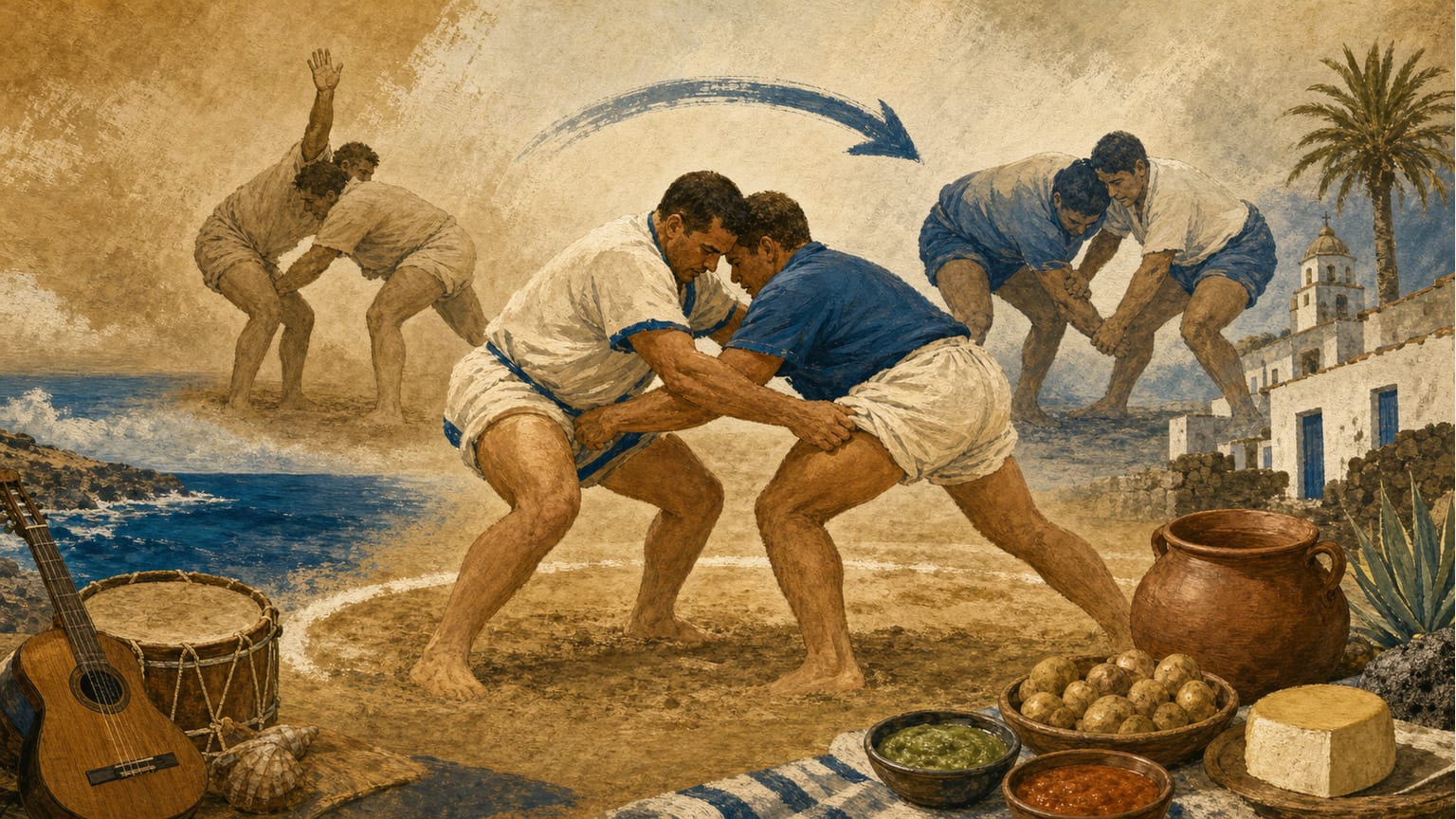
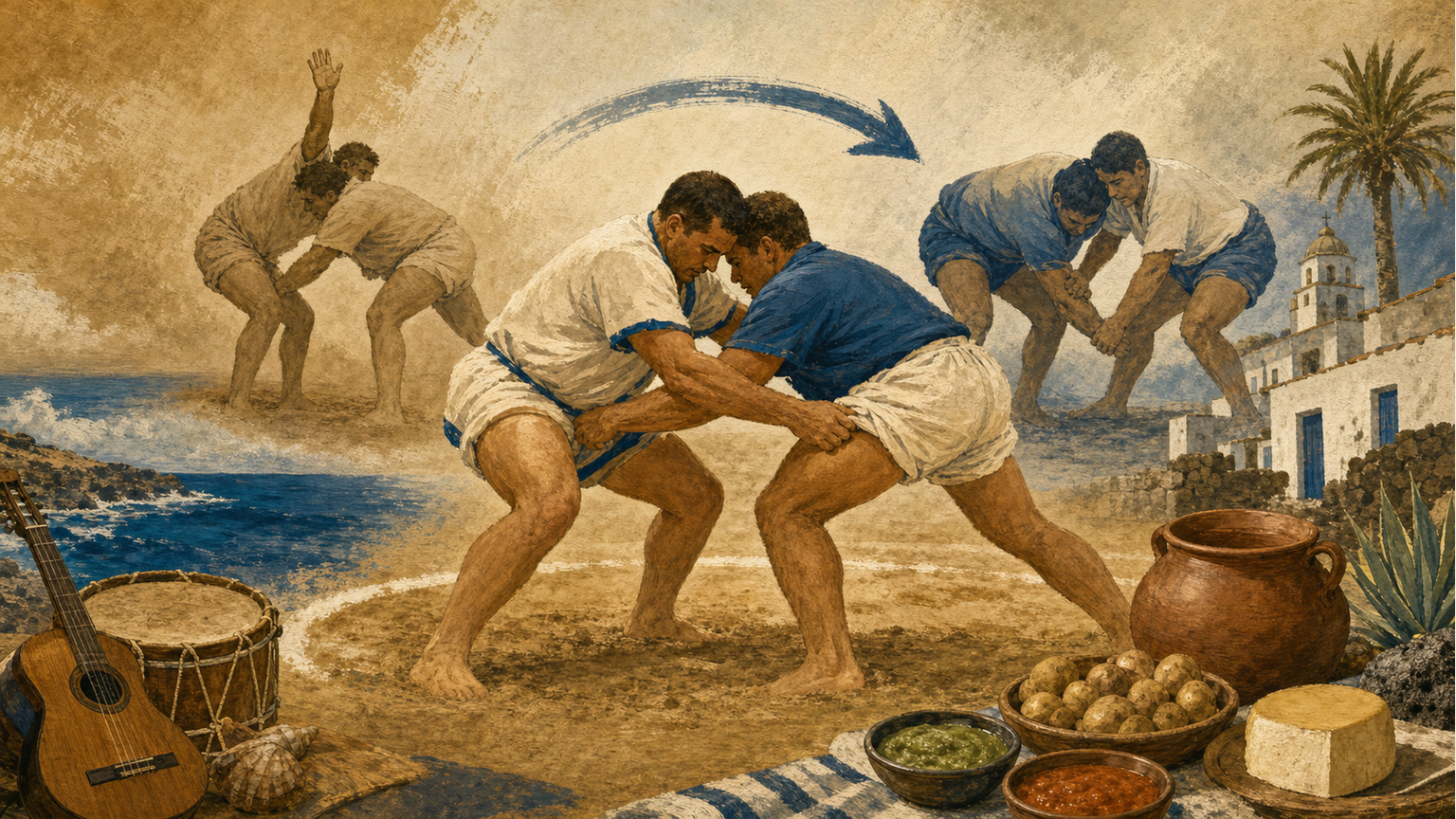
The evolution of the wrestling grip in Canarian wrestling according to Marrero Hernández
In his 1948 work, Luis Marrero Hernández provides a detailed account of the evolution of the grip technique in Canarian wrestling, focusing on the transition from the traditional “upper hand” (mano arriba) to the “lower hand” (mano abajo) style and its consequences for the sport in Gran Canaria and the rest of the archipelago[1].
According to Marrero Hernández, the traditional style in Gran Canaria allowed each wrestler to grip “in their own way,” which involved using wide trousers and placing the left hand through the trouser leg opening, with the thumb out at the waistband[1]. This favored techniques such as the levantada, cango, and burra, and was practiced mainly chest-to-chest[1].
The arrival of wrestlers from other islands, especially Lanzarote, Fuerteventura, and El Hierro, introduced the “lower hand” grip, which gradually gained ground in Gran Canaria[1]. This change came about after inter-island matches, where it was agreed that each wrestler could grip as they wished, but the “lower hand” technique proved effective for both attack and defense[1].
Marrero Hernández recounts how, after the first matches using the new style, Gran Canaria wrestlers, initially used to the “upper hand,” quickly adapted and developed new techniques such as the desvío, revoliada, thigh hold, traspíes, cadera, chascona, and garabato[1]. He attributes this adaptation to the natural skill and disposition of local wrestlers, who overcame the challenges of the new grip[1].
However, the author argues that neither the “upper hand” grip nor the use of wide trousers offers an inherent advantage, and believes that each wrestler should be able to grip as they prefer, since true skill lies in adaptability and technical mastery[1].
By the 1940s, Marrero Hernández observes that most wrestlers in Gran Canaria had adopted the “lower hand” grip, even those who traditionally fought with the “upper hand”[1]. He highlights Víctor Almeida, known as Artillero I, for his attacking ability using the “lower hand,” in contrast to other wrestlers who used this grip mainly for defense[1].
Marrero Hernández’s testimony captures a moment of transformation in Canarian wrestling, where technical evolution and the wrestlers’ adaptability enriched the sport and consolidated new styles that are now part of its identity[1].