

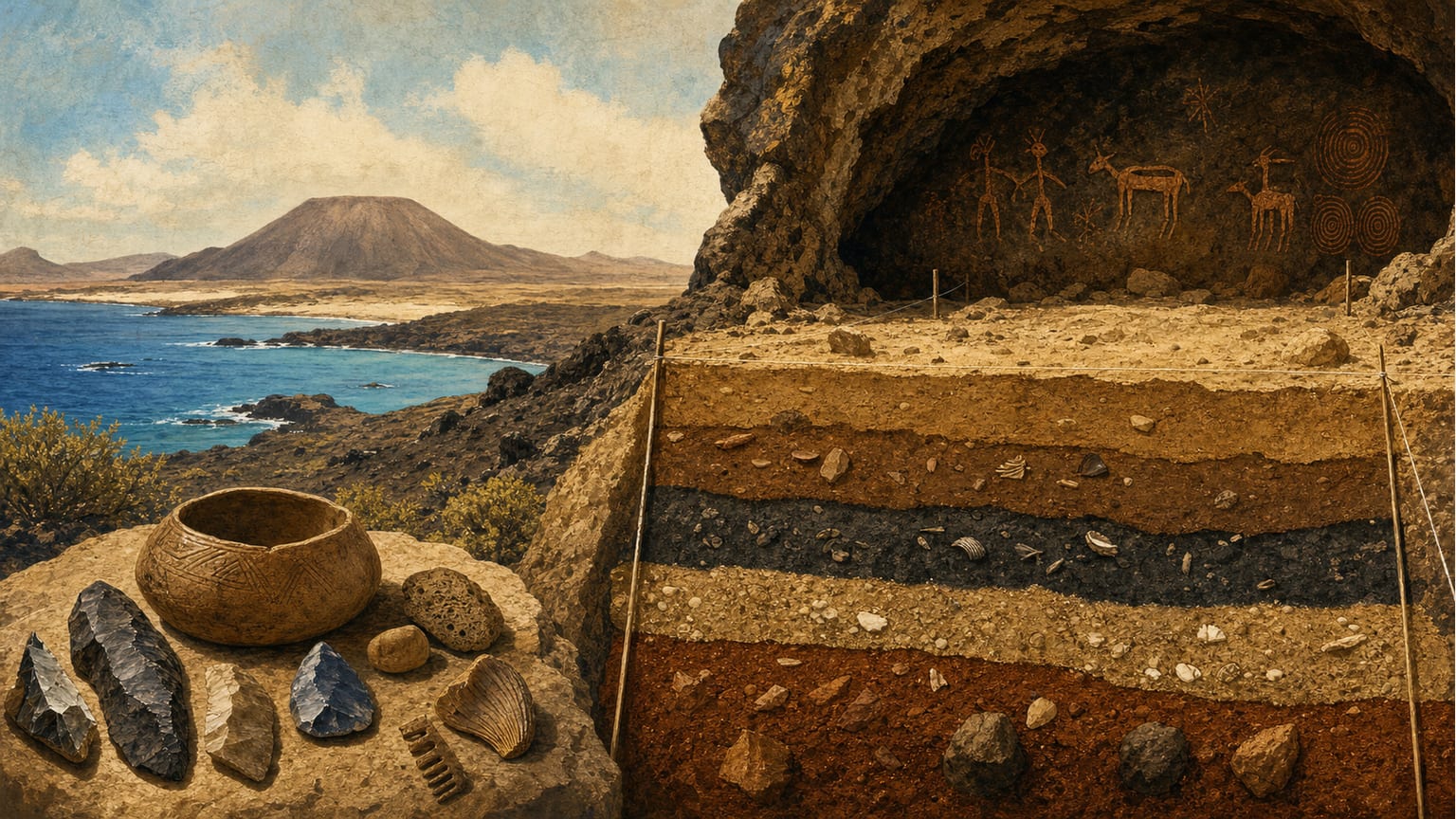
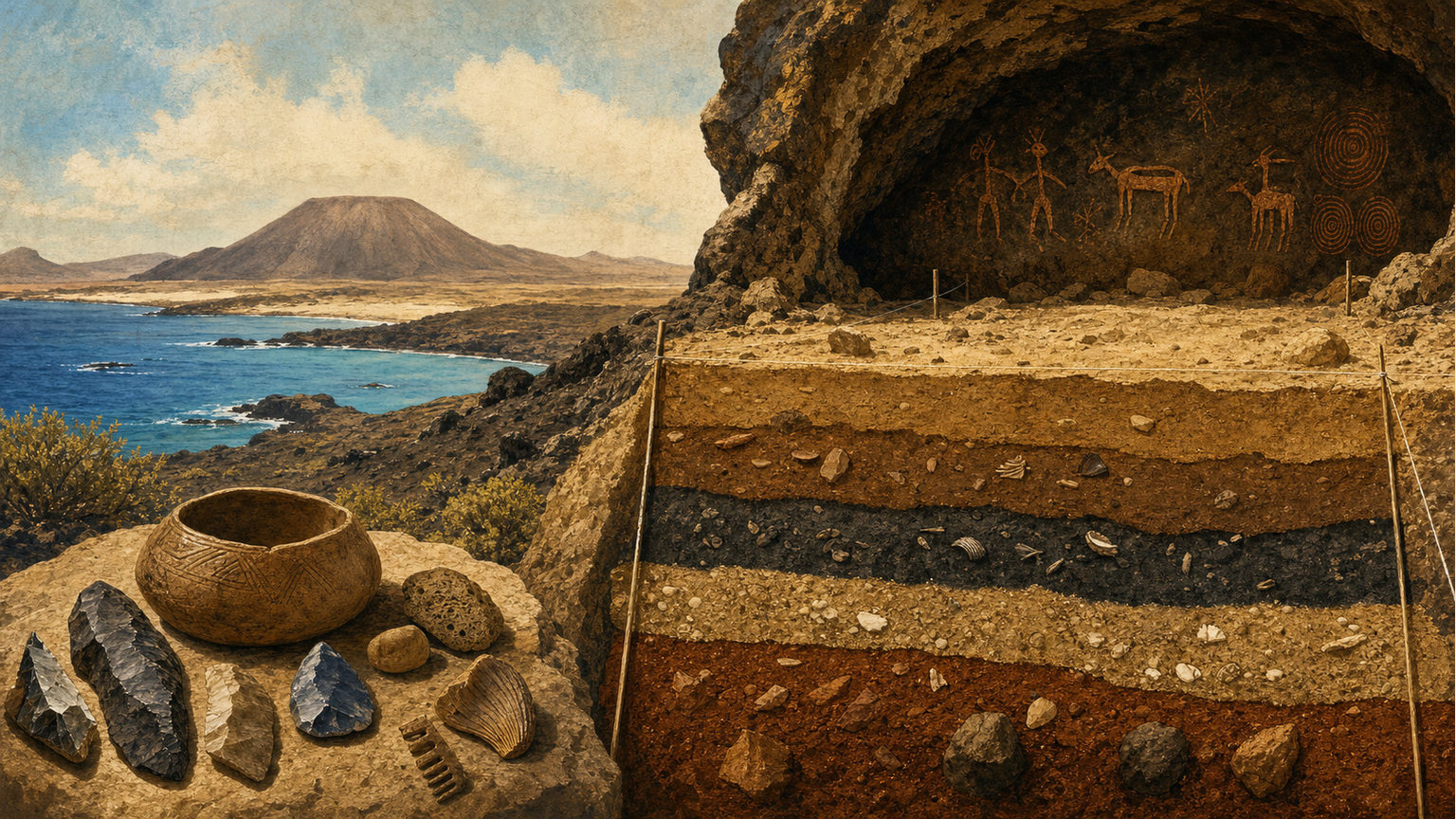
The archaeological site of El Bebedero, located in Tiagua (Teguise, Lanzarote), stands out for its well-preserved stratigraphic sequence, composed of five main layers. This sequence has enabled researchers to reconstruct essential aspects of Lanzarote’s cultural and environmental evolution during prehistory[1].
Layer V: Deep Origins
The deepest layer, V, is found from -1.08 m to -1.80 m. It consists of loose reddish-yellow clay mixed with stones. Notably, microfauna typical of humid environments were found here, suggesting wetter past conditions. Archaeological materials are scarce, mainly handmade pottery fragments with discontinuous firing and heterogeneous tempers. No decorative motifs were found on ceramics from this layer[1].
Layer IV: Consolidation and Faunal Remains
Layer IV, between -0.58 m and -1.05 m, is made up of compact light brown clay with many stones. At its base, a significant accumulation of faunal remains was found, along with pottery and other artifacts. The pottery is still handmade, mostly amorphous fragments and rims with straight or divergent orientations. Firing is mainly continuous, with oxidizing fire being most common. Both homogeneous and heterogeneous tempers are present, and surfaces are usually smoothed or roughly smoothed[1].
Layer III: Pottery Boom and Diversity
Layer III, from -0.46 m to -0.58 m, contains the highest number of pottery fragments in the sequence. Most pottery is undecorated, but the first decorative motifs appear, made by incision and impression. Rim fragments show straight, convergent, and divergent orientations, and lips are usually flat or rounded. Firing is continuous and oxidizing fire predominates. Tempers are mainly heterogeneous and fine or fine-medium in size. Bone remains of goats, sheep, and pigs were found, as well as marine fauna (fish, limpets, and top shells)[1].
Layers II and I: Surface Levels and Modern Disturbance
Layers II and I are the most superficial, affected by recent agricultural activities. They are composed of fine sand and compact clay, respectively, and contain very few archaeological materials, mainly amorphous pottery fragments and bone remains. These levels represent the modern agricultural sand cover that overlies the aboriginal layers[1].
Importance of the Stratigraphic Sequence
The stratigraphic sequence at El Bebedero has, for the first time in Lanzarote, provided solid data on the economic and environmental foundations of aboriginal culture and its material evolution. The clear differentiation of layers and the variety of materials recovered offer a detailed view of cultural and environmental changes over time, including adaptation to the island environment and the possible arrival of new population groups[1].
Methodology and Future Perspectives
Work at El Bebedero was based on rigorous methodology, with systematic excavation of grids and detailed analysis of each layer. Multidisciplinary collaboration enabled the acquisition of new data on fauna, pottery, and natural resource use. The results are a fundamental contribution to the knowledge of Lanzarote’s prehistory and form the basis for future research at other sites on the island[1].