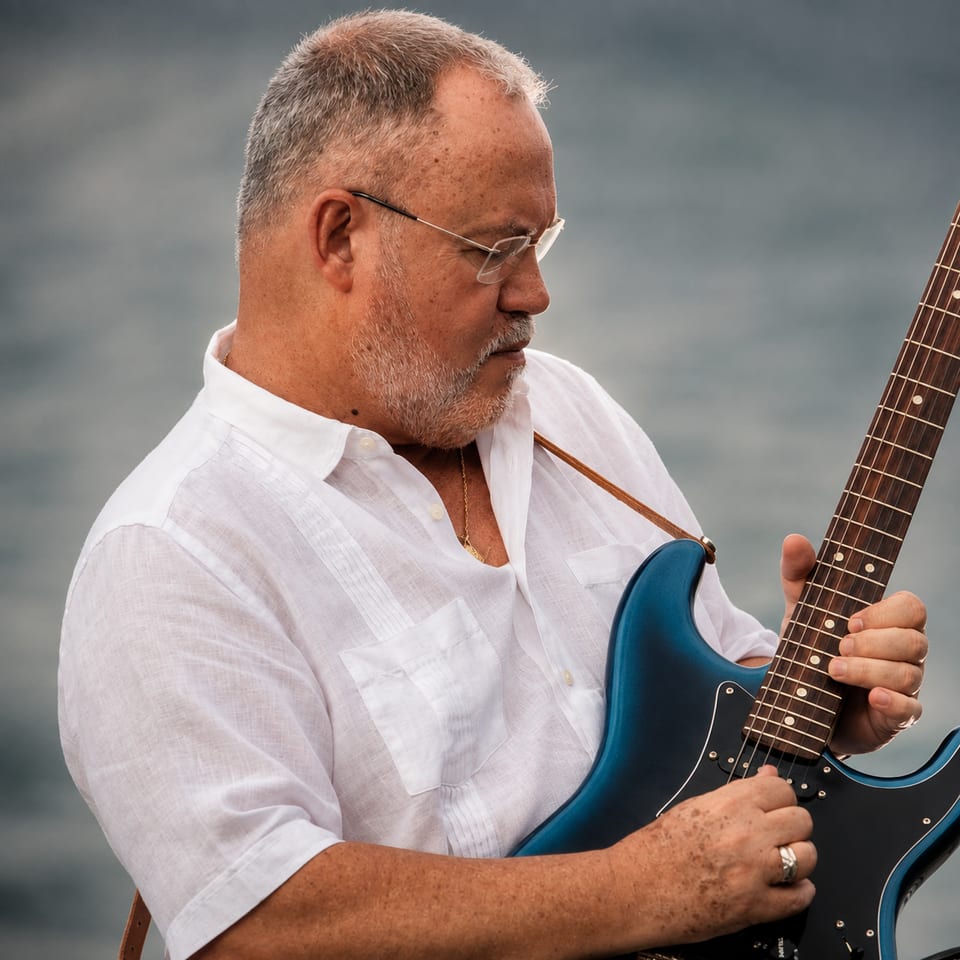
Music career
Born in Wimbledon in 1960, Enrique Mateu began learning the timple at the age of six at the Totoyo Millares Academy in Gran Canaria. He earned an advanced classical-guitar qualification at Madrid’s Royal Conservatory and continued his studies at centres in Spain, Portugal, Italy and England. After starting out with the fusion band KEY, he worked from 1986 to 1992 as a touring musician, studio guitarist and musical director. The return of his professional activity to the Canary Islands opened a period focused on composition, production and multidisciplinary projects; he has directed INEXART since 1990 and has also taught electroacoustic composition at the Canary Islands Conservatory of Music.
Contribution
The distinctive feature of his career is the way it brings Canarian roots into dialogue with electronics, electroacoustic music, video and stage creation. Founded in 1996, ARTENARA developed this approach through fieldwork and contemporary readings of the archipelago’s sounds, images and traditions. Later projects such as #(928) and Timple Digital extended that research to computers, real-time projection and electronic processing of the timple.
Style
His work moves between two complementary poles: timbral research using sampling, loops, editing and electroacoustic manipulation, and a more direct melodic form of writing. On albums such as Ritual Collage he combines instruments and material from different traditions; in Eroi Rotti he starts exclusively from the sound of the timple and transforms it through analogue and digital means. This breadth explains why his catalogue ranges across contemporary music, world music, rock, improvisation and sound art.
Repertoire
His solo catalogue documents fifteen releases between Formas Millares (1987) and Happy Birthday (2016). It includes albums conceived years before publication—Pandora was composed in 1992 and released in 2004, while Lancelot was recorded live in 1994 and issued in 2001—alongside electroacoustic works such as Eroi Rotti and sound-art collections such as Esculturas Sonoras. This output is complemented by thirteen works directed with ARTENARA, collaborative series with EXPRESSESION, #(928) and Rías Lejanas, and music for films, installations and productions by other performers.
Legacy
His contribution extends beyond a discography to music production, teaching, artistic direction and the creation of structures for contemporary music in the Canary Islands. He has promoted collaborative models in which musicians, visual artists, writers, dancers and programmers share a single work. His advocacy of copyleft and early use of digital formats, multimedia works and online distribution make circulation and access part of his artistic practice.
Canary Islands connection
Although he was born in London, he spent his childhood in Gran Canaria and began playing the timple there. After his professional period in Madrid, he moved INEXART’s activity to the Canary Islands in 1992 and made the archipelago the centre of numerous projects. ARTENARA works with the islands’ music, images, literature and traditions; projects such as Tewiza brought together material from all seven islands, while Timple Digital carried the Canarian chordophone into electronic and electroacoustic music.