

ContemporaryScience19th CenturyVolcanoes and mineral collections
Geologist and university professor
He investigated the geology of the Canary Islands and reorganised the mineralogical and petrographic collections of El Museo Canario in 1925–1926.
Geologist and university professor · 1869–1930
Geologist and university professor
He investigated the geology of the Canary Islands and reorganised the mineralogical and petrographic collections of El Museo Canario in 1925–1926.
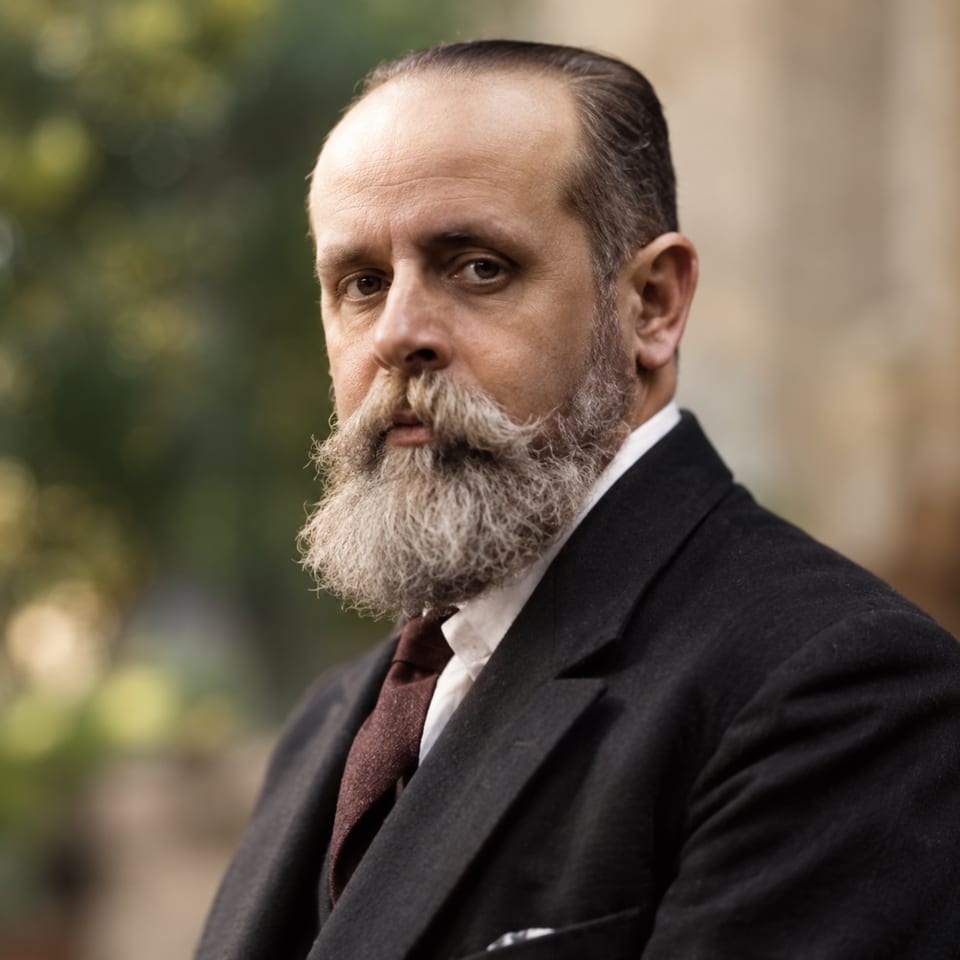
Lucas Fernández Navarro was born in Guadalajara on 3 January 1869. He died in Madrid on 31 October 1930. A geologist specialising in crystallography and mineralogy, he developed his career at the Central University and the National Museum of Natural Sciences. His expeditions to the Canary Islands and his work on the collections of El Museo Canario linked field research with the classification and conservation of specimens. The island institution recognised his contribution to the study of the archipelago’s rocks and volcanoes.
He was the son of Inocencio Fernández-Abas and Luisa Navarro Ibarra. His father taught mathematics at the provincial secondary school in Guadalajara, where Lucas completed his secondary education in September 1884. The following year he moved to Madrid to study natural sciences at the Central University. During his training he worked with the professor Francisco Quiroga y Rodríguez. In 1890 he became associated with the National Museum of Natural Sciences as Quiroga’s assistant, and he completed his university degree in July 1891.
He defended his doctoral thesis in 1893. His teaching career took him to chairs of natural history in Linares in 1897 and Almería in 1898; in 1900 he exchanged the latter position for one in Soria. In 1902 he obtained the chair of crystallography in the Faculty of Sciences at the Central University, adding the chair of mineralogy in 1911. These responsibilities accompanied research involving expeditions, publications and participation in scientific organisations. He became a full member of the Royal Academy of Exact, Physical and Natural Sciences in 1923 and president of the Spanish Royal Society of Natural History in 1927.
His Canarian explorations began on El Hierro in 1906. They continued in 1909 and between 1916 and 1926, with visits to Tenerife, La Palma, Gran Canaria, Lanzarote and Fuerteventura. The study of volcanoes formed a central part of this work. In 1926 he published Islas Canarias, a monograph prepared for excursion A-7 of the Fourteenth International Geological Congress. It combined text, maps and plates for the scientific visit organised in connection with the congress held in Madrid.
His association with El Museo Canario brought specific improvements to its collections. In January 1924 he donated a classified collection of rocks from Gran Canaria and Mount Teide, and the following month the museum made him an honorary member. Between August 1925 and 1926 he standardised and reclassified its mineralogy and petrography cabinet. He also led the expedition of congress participants who visited Gran Canaria, Tenerife and La Palma before the 1926 meeting. A degenerative illness that developed in 1928 brought his professional career to an end. Following his death, the museum promoted the naming of a street in his honour. In 1932 its mineralogical and petrographic exhibition room became the Sala Fernández Navarro, commemorating the work he had carried out on its specimens.