

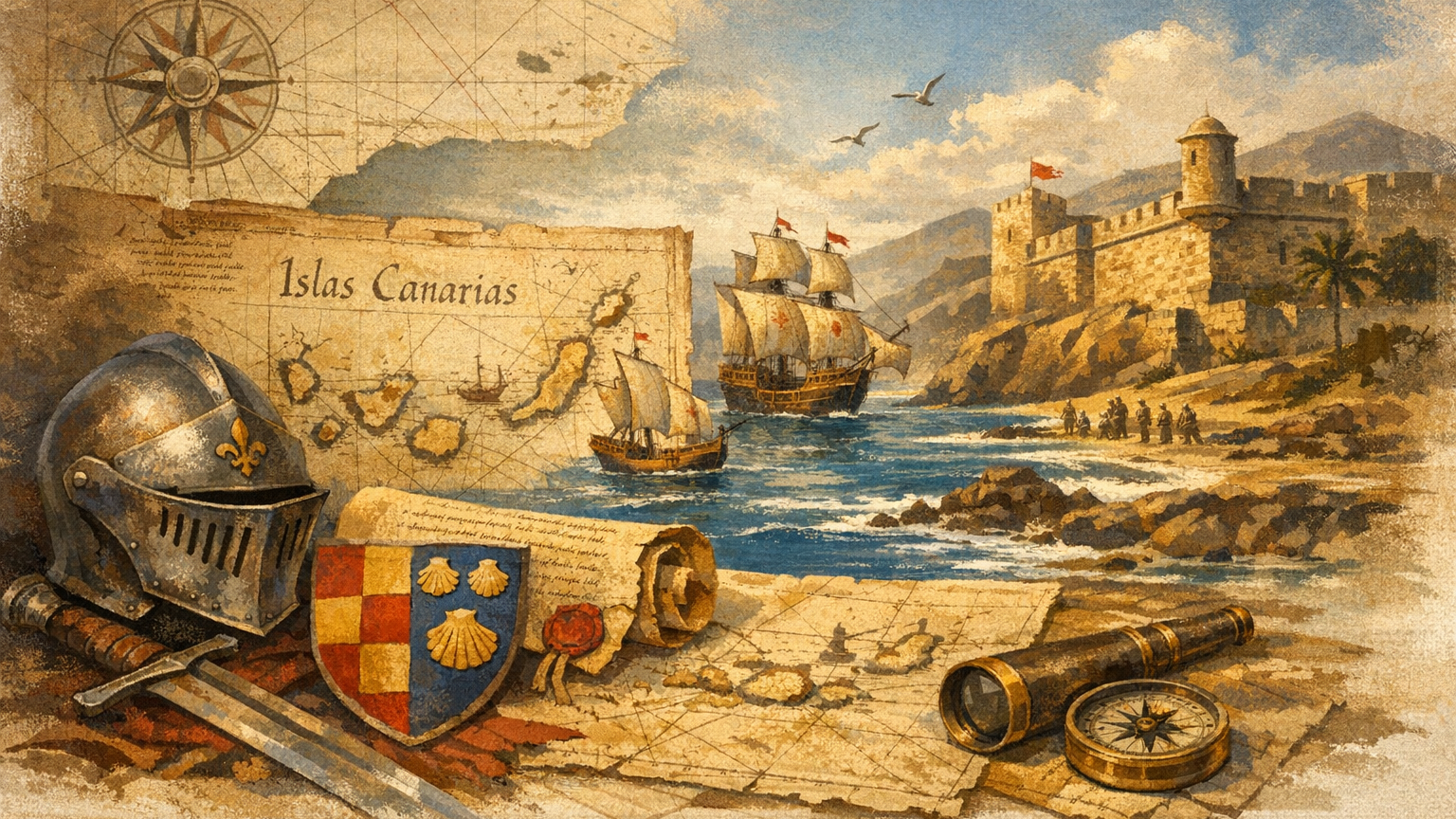
The conquest of the Canary Islands is inseparable from the story of the Béthencourt family, whose origins trace back to the depths of medieval France. The Béthencourt surname is among the oldest in France, emerging from the fusion of the Germanic name Betto and the suffix “court” (meaning estate or manor), a naming pattern common since the Frankish era[^serra-y-cioranescu-1959-le-canarien-tomo-i].
Initially, there was a Betto, then his estate—Bettoncourt or Béthencourt—and eventually a succession of descendants who adopted the property’s name. The proliferation of places and castles named Béthencourt across northern and northwestern France makes it nearly impossible to pinpoint a single origin or to confirm that all Béthencourts share a common ancestor[^serra-y-cioranescu-1959-le-canarien-tomo-i].
One prominent possible origin is the castle of Béthencourt-sur-Somme in the Vermandois region, east of Amiens. This fortress played a strategic role during the Hundred Years’ War and was a favored stop for French royalty and nobility. However, the spread of the Béthencourt name led to numerous homonymous fiefs in Picardy, Normandy, and beyond, further complicating genealogical research[^serra-y-cioranescu-1959-le-canarien-tomo-i].
The earliest documented Béthencourts appear in the 11th century, with figures like Hugues and Wauthier de Béthencourt in Cambrésis. Over time, the family branched into various lines, intermarrying with other noble houses and acquiring new estates. The relationship between the Béthencourts of Vermandois and those of Normandy—home to Jean de Béthencourt, the leader of the Canary Islands conquest—remains debated. While tradition suggests a direct link, the lack of definitive documentation leaves the question open, though the shared heraldic symbol of the rampant lion hints at a symbolic connection[^serra-y-cioranescu-1959-le-canarien-tomo-i].
In Normandy, the Béthencourt fief at Sigy-en-Bray is recorded as early as 1040, possibly founded by a Norman leader named Boton. Through the 13th and 14th centuries, the Norman Béthencourts solidified their status as lords of several fiefs, actively participating in the region’s military and political affairs. Jean de Béthencourt, who would lead the 1402 expedition to the Canary Islands, emerged from this long familial evolution, shaped by alliances, conflicts, and the dynamics of feudal France[^serra-y-cioranescu-1959-le-canarien-tomo-i].
Thus, the Béthencourt lineage is not only central to the history of the Canary Islands’ conquest but also exemplifies the broader patterns of medieval noble families—how they expanded, diversified, and left their mark on European and Atlantic history.