

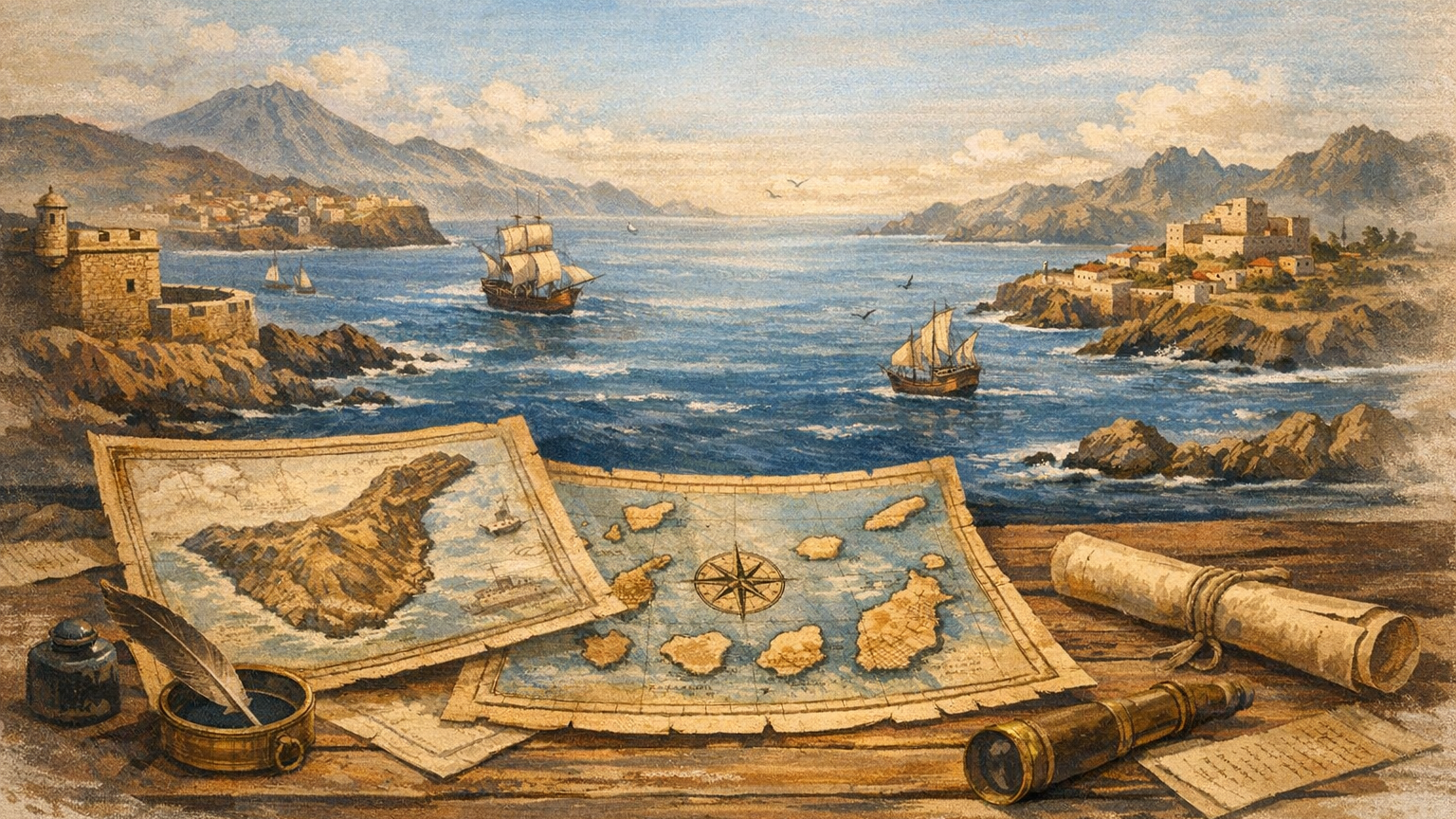
The urban history of the Canary Islands is inseparable from their unique and fragmented geography. During the Early Modern period, the archipelago’s physical configuration—with rugged islands, deep ravines, and jagged coastlines—created a form of ‘double insularity’: not only did the sea separate the islands, but the very terrain hindered communication and harmonious development within each island[^la-jerarquia-y-el-sistema-urbano-de-cana].
Except for Fuerteventura and Lanzarote, which are relatively flat, most islands are marked by steep landscapes crisscrossed by ravines. While these allowed some contact between the coast and the interior, they made travel between different settlements difficult. This internal fragmentation fostered the isolation of communities and limited social and economic integration, leading each urban or rural center to develop its own, sometimes disconnected, dynamics[^la-jerarquia-y-el-sistema-urbano-de-cana].
The sea played an ambiguous role: it was the route for exporting agricultural and artisanal products and for importing culture and wealth, but it also acted as a barrier that heightened isolation. The depth of the ocean and the variety of currents did not prevent exchanges, but suitable harbors were scarce. Many landing places were inaccessible for parts of the year, and some, like Garachico’s port, were destroyed by volcanic eruptions, leading to the decline of their cities[^la-jerarquia-y-el-sistema-urbano-de-cana].
Land routes were winding and impractical, with transport limited mainly to camels, making other, more efficient means secondary. This further reinforced the isolation between regions and made the integration of island life more difficult. Additionally, factors such as climate, water scarcity, and irregular rainfall added to the challenges of life and agricultural development, affecting where and how urban centers grew[^la-jerarquia-y-el-sistema-urbano-de-cana].
This ‘double insularity’ had deep social and economic consequences. The driest islands, like Fuerteventura and Lanzarote, maintained small, fluctuating populations, while areas with better climate and water attracted more inhabitants. The fragmented space also prevented the formation of large estates, forcing elites to accumulate small, scattered plots, which reinforced the concentration of power and wealth in the hands of a few[^la-jerarquia-y-el-sistema-urbano-de-cana].
In summary, the fractured geography of the Canary Islands not only dictated the pace and pattern of urbanization but also shaped the islands’ social structure, economy, and politics. Double insularity is key to understanding the uniqueness of the Canarian urban system and its historical evolution.