

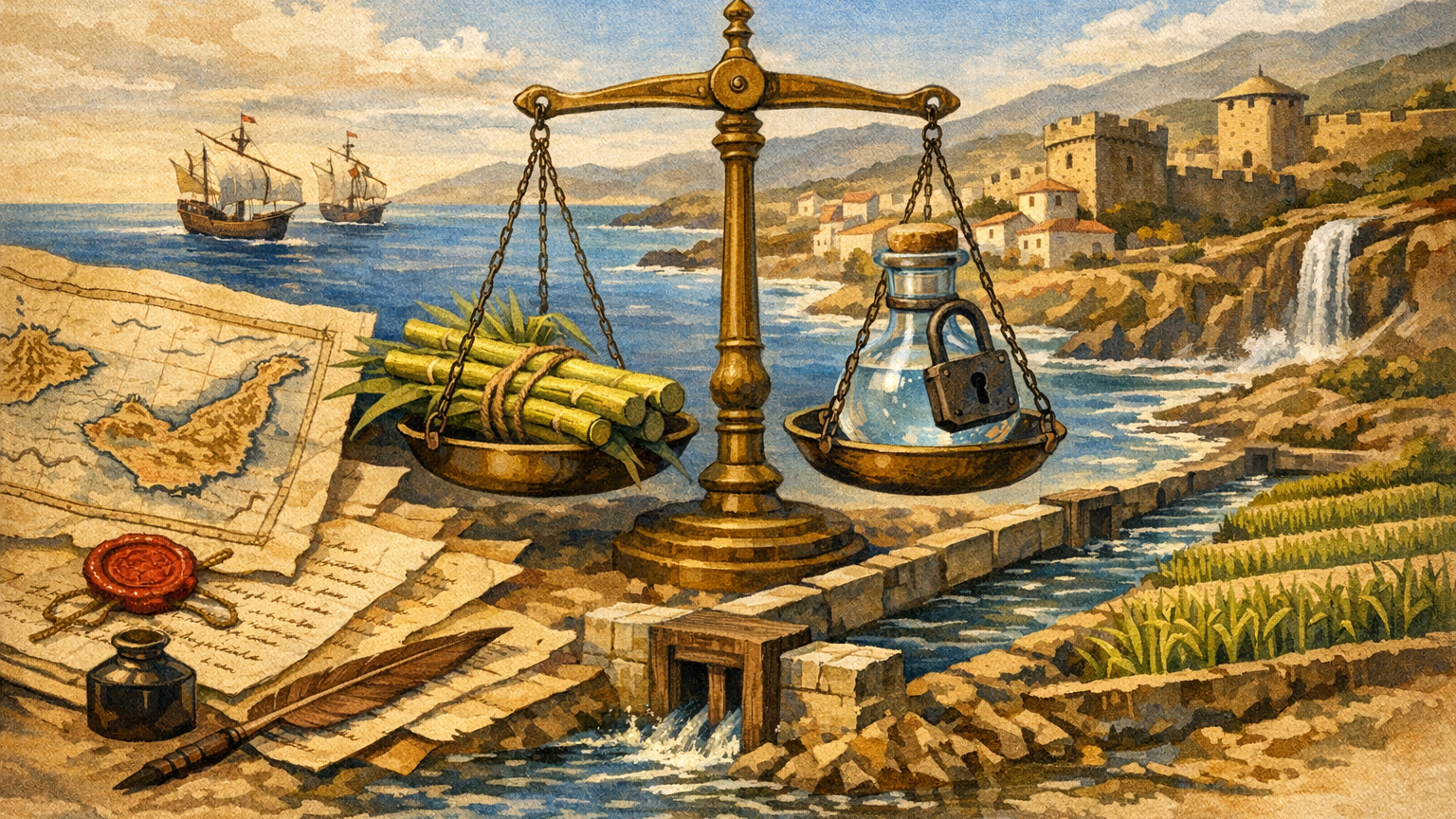
Sugarocracy and the Privatization of Water in Sugar-Era Canary Islands (1480-1525)
During the late 15th and early 16th centuries, the Canary Islands witnessed a profound transformation driven by the rise of a powerful sugar elite—the so-called “sugarocracy.” This group fundamentally altered the management and ownership of water, a resource essential for the booming sugar industry, and established a unique legal culture around water rights1.
Water: The Engine of Sugar Agroindustry
Sugarcane cultivation demanded fertile land and, above all, a reliable water supply. In Gran Canaria and Tenerife, the initial distribution of land and water followed Castilian legal models, but the rapid expansion of sugar production soon created tensions. The growing demand for water led to the emergence of a water market and the separation of water rights from land ownership.
From Common Good to Private Property
At first, water was managed as a communal resource by institutions known as Heredamientos, which regulated its use among settlers. However, as the sugar industry expanded, the sugarocracy—composed of conquerors, major merchants, and Genoese bankers—leveraged their influence to change the rules and facilitate the privatization of water. Water became a commodity: it could be bought, sold, or leased, and access increasingly depended on capital invested in hydraulic infrastructure such as canals, reservoirs, and maretas1.
The ‘Remuda’ of Exhausted Lands and Sugarocracy’s Dominance
A key mechanism in this process was the “remuda of exhausted lands”: when sugar fields lost their fertility, water rights allowed owners to transfer water to new plots, often displacing small dryland farmers. In this way, the sugarocracy accumulated large estates and controlled most of the available water, while the rural population was marginalized.
A Unique Hydraulic System
The result was a hydraulic system based on private ownership and management of water, a stark contrast to the original communal model. This transformation, driven by European market pressures and the need to maximize sugar output, had deep social and economic consequences, and its legacy is still evident in the Canary Islands’ water culture today1.