

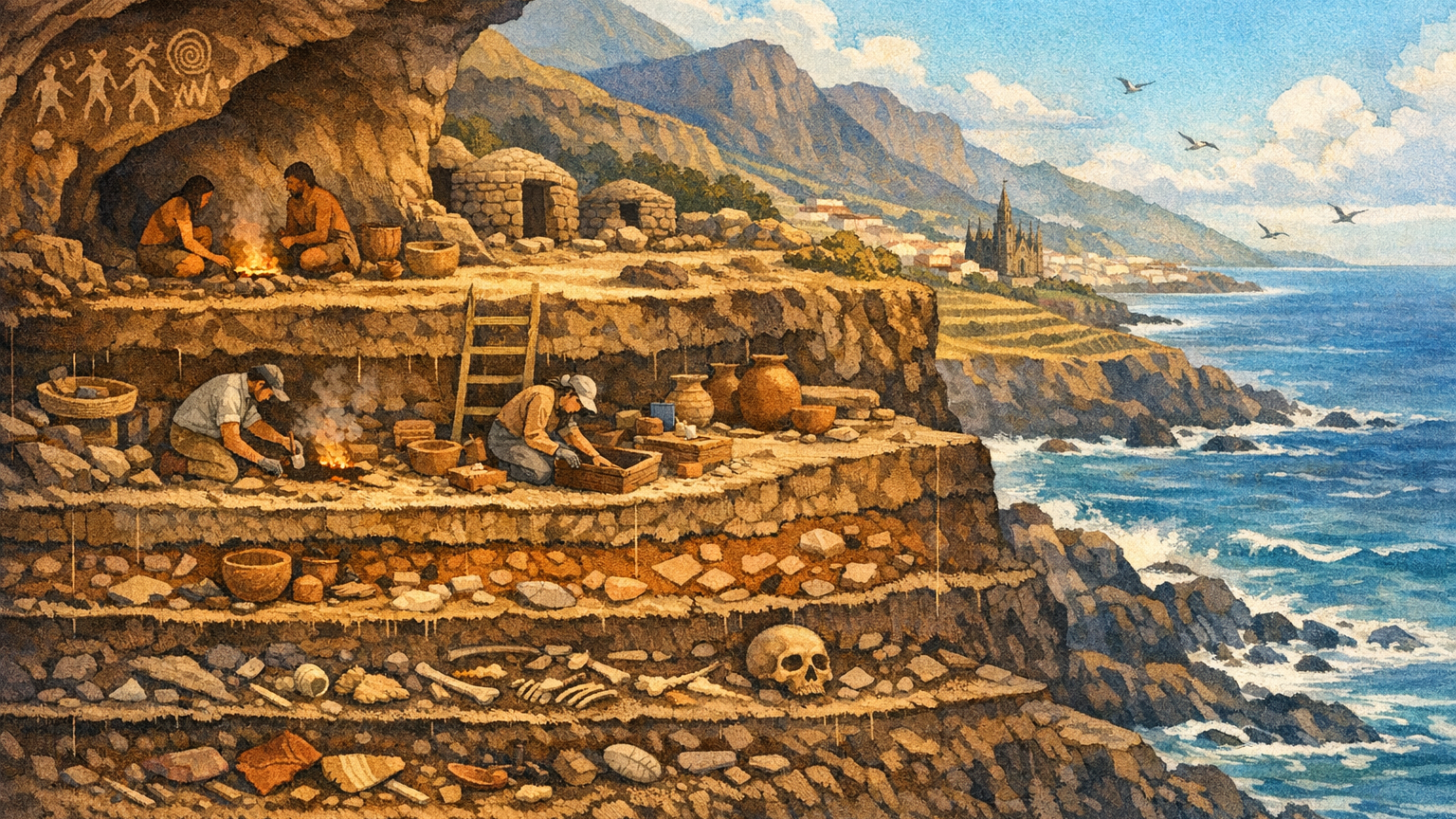
La Cerera: Stratigraphy and Human Occupation in Arucas
The archaeological site of La Cerera, located on the southern slope of the Montaña de Arucas, stands out as an exceptional case for understanding pre-Hispanic human occupation in Gran Canaria. Its significance lies in its well-preserved stratigraphic sequence, over two meters thick, which allows researchers to analyze both natural processes and human activities that have shaped the site over centuries[^el-yacimiento-arqueologico-de-la-cerera-un-modelo-de-ocupacion-en-la-isla-de-gran-canaria].
A Unique Geological and Climatic Setting
La Cerera cave was formed within the volcanic context of Arucas, a cone over 400 meters high composed of tephronolites and phonolites. The surrounding landscape is complex, with varying slopes and an endorheic basin that once favored water accumulation. The climate is semi-arid, with irregular rainfall and a nearly permanent water deficit, which influenced how ancient communities used and occupied the space[^el-yacimiento-arqueologico-de-la-cerera-un-modelo-de-ocupacion-en-la-isla-de-gran-canaria].
Cave Formation and Infilling
The cave’s formation is linked to volcanic activity and erosion. After a gas bubble formed beneath a lava layer, erosion eventually exposed the cavity, initiating infilling processes. Sedimentological analysis has identified several key episodes:
- Initial Collapses: Large blocks and stones fell from the cave ceiling, forming the first levels without archaeological remains, indicating a natural origin before human occupation.
- First Anthropogenic Deposits: Later, sediments rich in organic matter and phosphorus, along with abundant archaeological remains, accumulated—clear evidence of human presence. Radiocarbon dating places one of these levels between AD 620 and 700, providing a timeframe for pre-Hispanic occupation[^el-yacimiento-arqueologico-de-la-cerera-un-modelo-de-ocupacion-en-la-isla-de-gran-canaria].
- Subsequent Collapses and New Infills: Over time, further collapses and sedimentation phases alternated between natural and anthropogenic layers. The presence of charcoal and material remains in some strata confirms ongoing occupation and the use of the cave as both a dwelling and functional space.
Importance for Canary Islands Archaeology
La Cerera is one of the few sites in Gran Canaria where absolute dating can be obtained within a broad stratigraphic sequence. This enables the reconstruction of occupation dynamics and changes in land use over time, providing key insights into the pre-Hispanic communities of Arucas and their adaptation to the environment.
Moreover, the interdisciplinary work at La Cerera—spanning geology, archaeobotany, and anthracology—has deepened our understanding of the site’s formation and its importance within the island’s archaeological heritage. Collaboration among public institutions, companies, and the local community has been crucial for preserving and promoting this site, demonstrating that integrating heritage into daily life is both possible and enriching[^el-yacimiento-arqueologico-de-la-cerera-un-modelo-de-ocupacion-en-la-isla-de-gran-canaria].
La Cerera thus stands as a model for archaeological study in Gran Canaria, a tangible testament to the interplay between nature and culture through the centuries.