

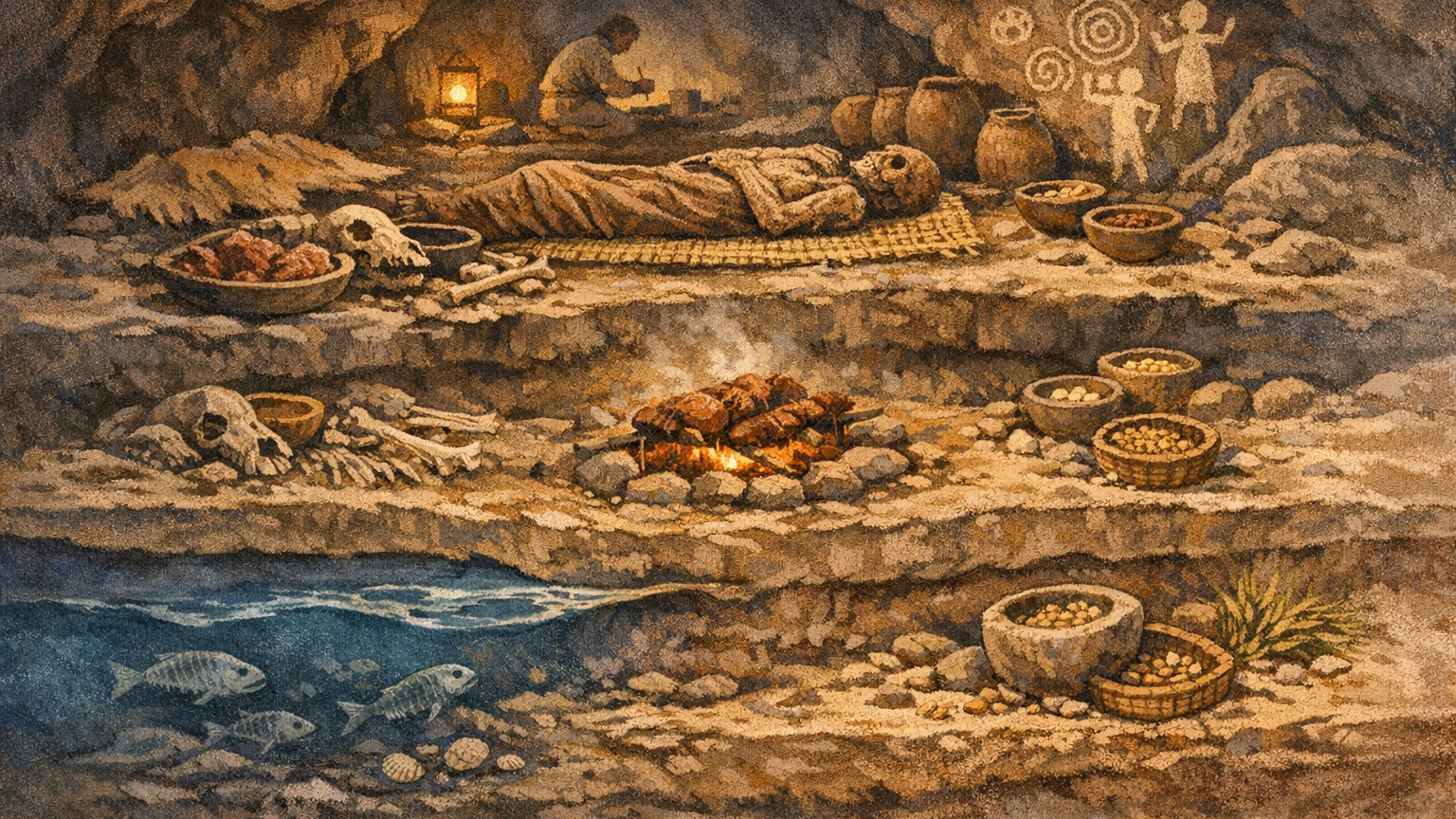
Reconstructing Guanche Diets: Insights from Mummy Analysis
What did the Guanches, the ancient inhabitants of Tenerife, actually eat? Recent bioanthropological research, notably from the CRONOS Project, has provided concrete answers through the chemical analysis of their mummified and skeletal remains1.
Scientific Methods
Researchers employed trace element analysis (strontium, calcium, zinc) and stable isotope analysis (carbon, nitrogen, sulfur) on bone samples. Careful selection ensured good preservation and representation from different regions and altitudes of Tenerife. In total, 171 bone samples—including 22 mummies—were analyzed for trace elements, and 250 skeletal samples for isotope studies1.
Findings: A Meat-Based Diet
The results are striking: the Guanche diet was predominantly meat-based, with much less reliance on plant foods and only minimal consumption of marine resources. The combination of trace element and isotope data allowed researchers to distinguish between terrestrial and marine food sources and to estimate their relative importance1.
This meat-heavy diet suggests an economy centered on herding and hunting, with limited use of plant and marine products. Moreover, these dietary patterns provide clues about social stratification and the degree of isolation among different Guanche communities on Tenerife.
Social and Cultural Implications
Reconstructing the Guanche diet not only reveals their eating habits but also offers insights into their social organization, adaptation strategies, and possible differences between northern and southern island communities. For example, geographic variations in dental pathologies were observed, linked to abrasive substances in the diet and a lack of refined sugars1.
A Model for Island Bioanthropology
The multidisciplinary approach of the CRONOS Project—combining chemical, paleopathological, and genetic analyses—has made Tenerife a leader in the study of prehistoric island populations. This research demonstrates how science can uncover key aspects of ancient Canarian life from their most silent witnesses: the mummies.