

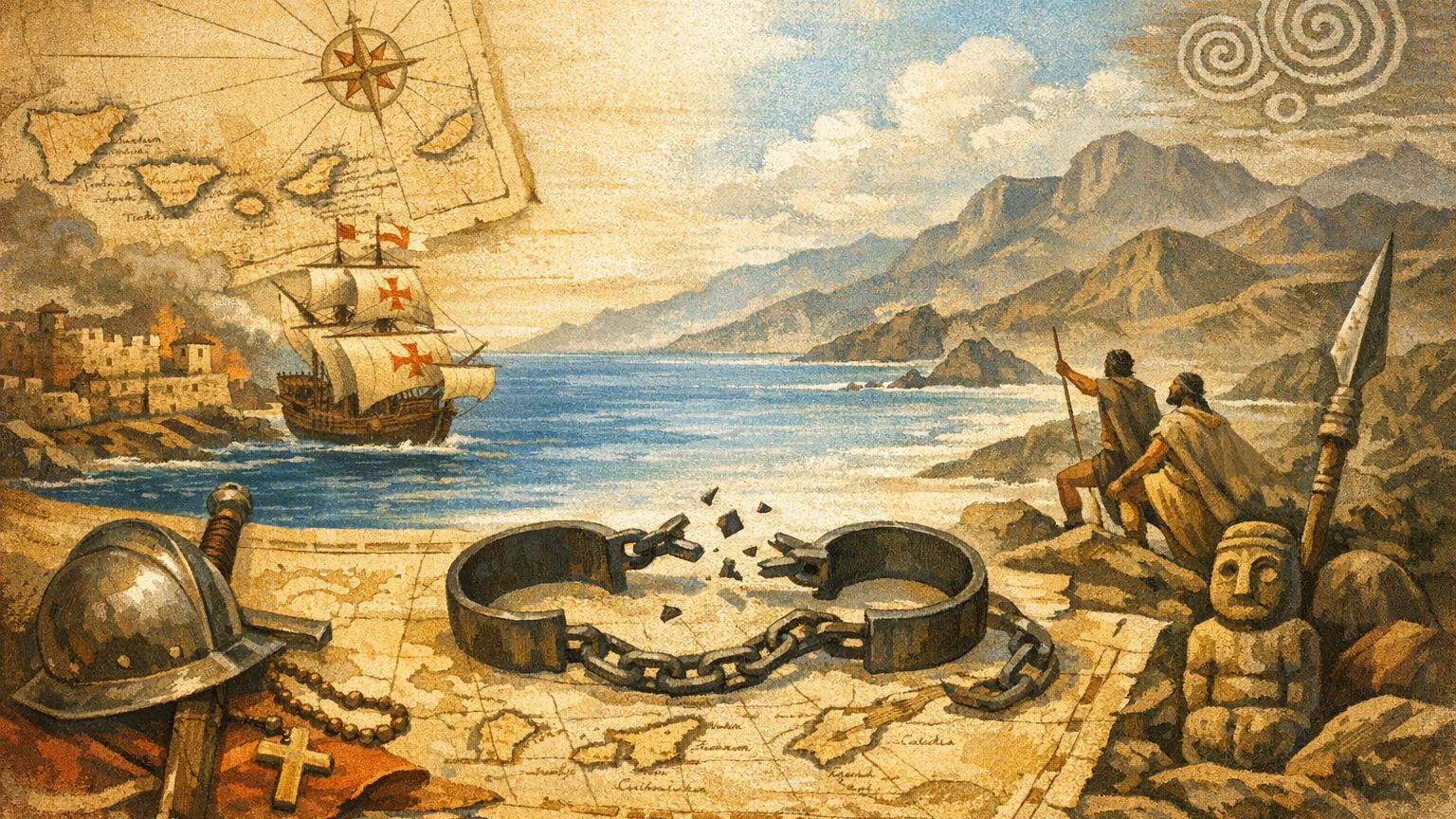
The Impact of Colonization on Guanche Society: Transformation and Resistance
The arrival of European conquerors in the Canary Islands brought not only political change but also a profound transformation of the lives of the Guanches, the archipelago’s original inhabitants. Colonization irreversibly altered their social organization, culture, and economy, marking the beginning of a new era in Canarian history1.
Disintegration of Guanche Society
The conquest and subsequent colonization led to the breakdown of Guanche social and cultural structures. Their magical-religious worldview was replaced by Christianity, imposed by the new rulers. The subsistence economy, based on agriculture and livestock, was replaced by an export-oriented model controlled by the conquerors1.
Demographic Changes and Acculturation
Europeans brought previously unknown diseases, such as the “modorra,” which decimated the aboriginal population. Many Guanches were sold into slavery or died in conflict, causing a severe demographic decline. Survivors underwent a process of acculturation and assimilation, although some groups maintained their identity, calling themselves “native islanders.” The so-called “alzados” resisted by retreating to remote areas, striving to preserve their traditional way of life1.
Mestizaje and Indigenous Protection
Not everything was destruction. Queen Isabella I of Castile’s policies aimed to protect the indigenous population, supporting the survival of some Guanches and encouraging mestizaje. The “bands of peace,” who accepted Castilian authority, generally suffered less, and women and children from the “bands of war” often escaped massacre. By 1504, the Canary Islands bishopric recorded about 1,200 aboriginal families, plus mixed families, totaling around 4,000 individuals1.
A New Social Structure
The post-conquest distribution of land created a new social structure: a dominant class of conquerors and assimilated aboriginal elites, a class of settlers and integrated Guanches, and a marginalized class of foreigners, Jews, and non-assimilated aborigines. This organization would persist for centuries, shaping social relations in the Canary Islands1.
Persistence of Guanche Identity
Despite acculturation and social pressure, Guanche identity did not disappear entirely. The “alzados” and some descendants preserved the memory of their origins, contributing to the islands’ cultural richness. Thus, although colonization was devastating, it did not entirely erase the Guanche legacy from Canarian history.