

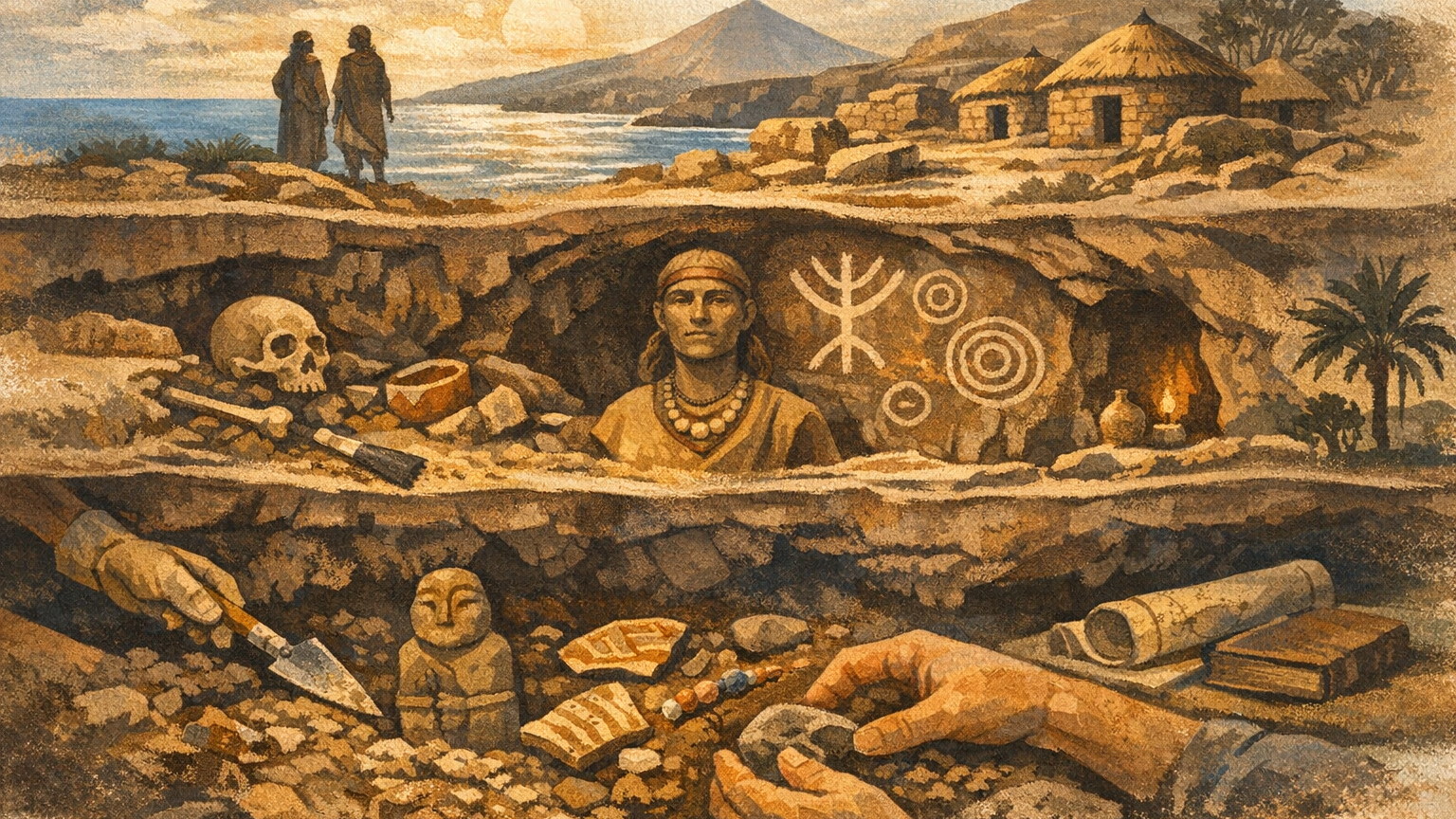
The Amazigh Roots of the Ancient Canarians: Identity, Archaeology, and Silences
The history of the Canary Islands is deeply intertwined with the Amazigh people of North Africa. Despite overwhelming scientific evidence, the Amazigh heritage of the islands’ indigenous populations has long been downplayed or even silenced in academic, museum, and political discourse1.
An Undeniable African Origin
Archaeological and genetic evidence shows that the first inhabitants of the Canary Islands came from Northwest Africa, specifically from Amazigh (Berber) communities. Mitochondrial DNA studies trace most indigenous Canarian lineages to Morocco, Tunisia, Algeria, and the Sahara. Cultural elements such as ceramics, Libyco-Berber inscriptions, and magical-religious practices further reinforce this link1.
Although all islands share a common Amazigh substrate, insular isolation led to the development of distinct island cultures, each with its own linguistic and cultural variations. The Amazigh culture in the Canaries thus became a unique and marginal phenomenon within the broader African context, shaped by adaptation to the environment and limited external contact after initial colonization1.
Silencing Amazigh Heritage
Remarkably, until well into the 21st century, the Amazigh heritage was almost absent from academic and museum narratives in the Canaries. Local archaeology tended to objectify indigenous culture, presenting it as static and homogeneous, more “Canarian” than Amazigh, reflecting political tensions and the construction of regional or national identity1.
The term “Berber”—of Greco-Latin origin and with negative connotations—was imposed by European and Arab traditions, while “Amazigh” is the self-designation used by these communities. Only in recent decades, especially in contexts of identity and independence movements, has “Amazigh” begun to replace “Berber” in the Canaries, following the lead of North African Amazigh activism1.
Museums and Heritage: Between Invisibility and Instrumentalization
Canarian museums have perpetuated a decontextualized and “dead” vision of indigenous culture, focusing on objects and material remains, without incorporating recent advances on Amazigh origins or fostering critical reflection on identity. Even when the African roots are acknowledged, they are often instrumentalized for political or economic purposes, as seen in cooperation projects with Morocco where “Amazighness” is used as a symbolic bridge1.
A Challenge Ahead
Making Amazigh heritage explicitly visible in the Canaries remains a political and social challenge. It requires updating academic and museum narratives and recognizing the plural and complex nature of Canarian identity, which is deeply connected to Africa. Only then can a more inclusive and accurate historical narrative of the ancient Canarians be built.