

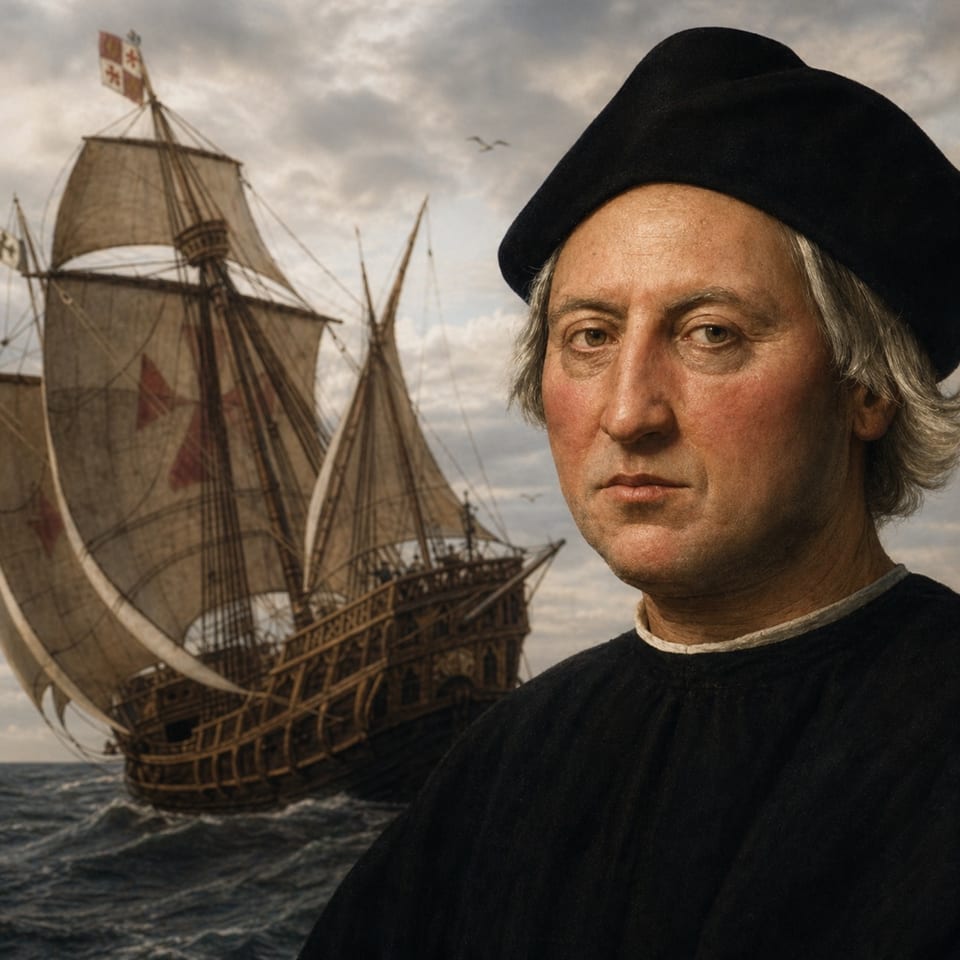
Conquista History 15th Century Discoverer of America
Genoese navigator
The Genoese navigator stopped at La Gomera during his four voyages to America, turning the Canary Islands into a strategic point on the Atlantic route.
Genoese navigator · 1451–1506
Genoese navigator
The Genoese navigator stopped at La Gomera during his four voyages to America, turning the Canary Islands into a strategic point on the Atlantic route.
Christopher Columbus chose the Canary Islands as his last European port of call before venturing into the unknown Atlantic Ocean. The islands offered constant trade winds blowing westward, fresh water, provisions and the possibility of ship repairs. On his first voyage (1492), he stopped at La Gomera, where the governor Beatriz de Bobadilla provided him with supplies and, according to legend, a romantic relationship. He set sail on 6 September 1492 into the unknown.
The Canarian stopover was repeated on all four Columbian voyages. Columbus repaired the Pinta's rudder at La Gomera on his first crossing. On the second voyage (1493) he stopped at Gran Canaria and La Gomera. On the third (1498) he passed through the eastern islands. On the fourth (1502) he again touched Gran Canaria. The Canaries thus became the gateway from Europe to the New World, and their geographical location proved decisive in the design of Atlantic trade routes.
The Columbian legacy lives on in the archipelago. The Torre del Conde in San Sebastián de La Gomera, where Columbus provisioned his fleet, is today a Historic Monument. In Las Palmas de Gran Canaria, the Casa de Colón (built on the site where he possibly lodged) houses a major museum. Columbus transformed the Canaries from an edge of the known world into the nerve centre of the Spanish Empire.