
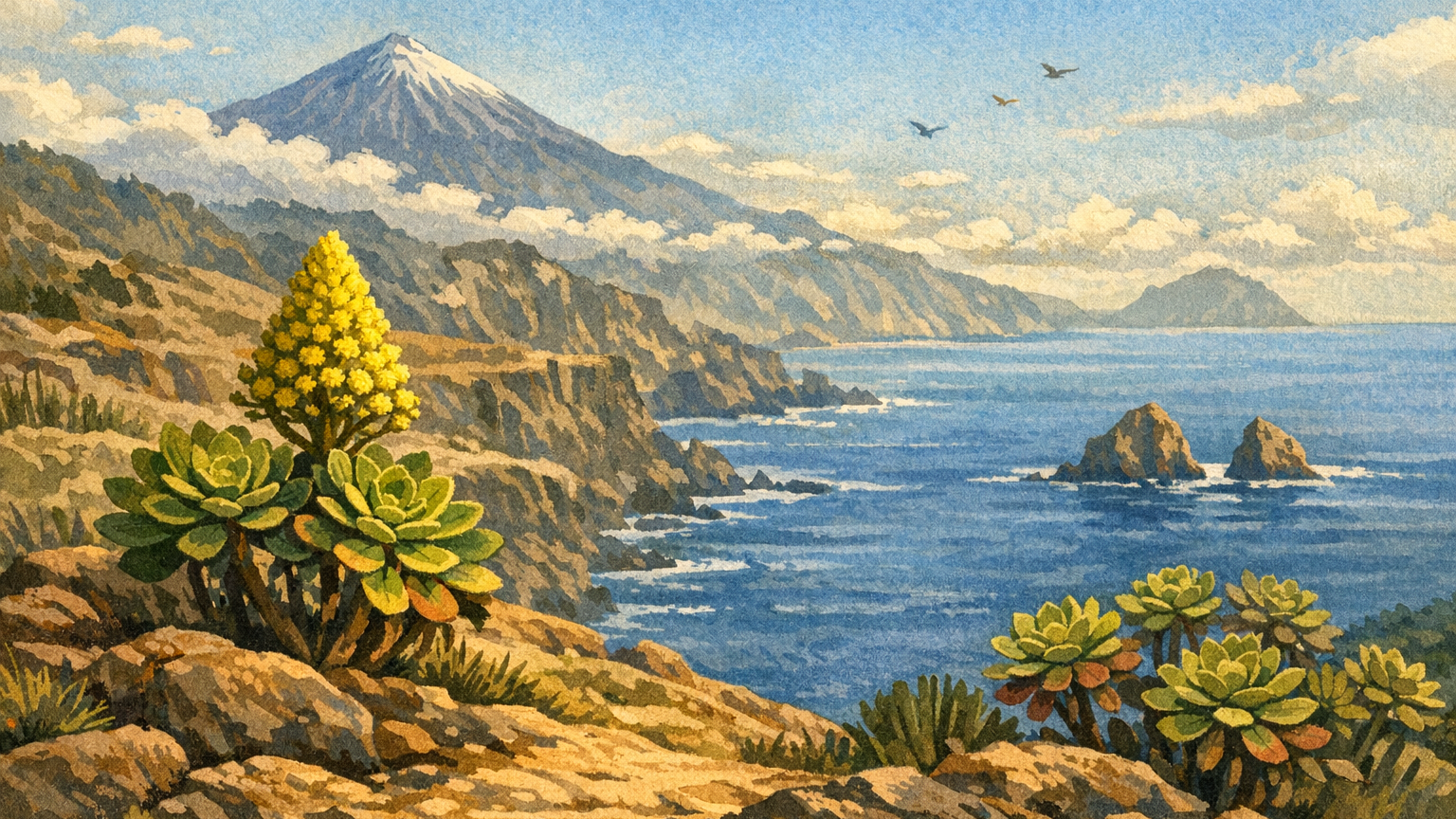
The flora of the Canary Islands is renowned for its diversity and uniqueness, with the Aeonium genus—commonly called veroles—standing out as a prime example. These succulent plants from the Crassulaceae family illustrate the phenomenon of adaptive radiation in island environments[^origen-y-evolucion-de-la-flora-y-fauna-de-las-istas-canarias].
Origins and Arrival in the Canaries
The ancestor of Aeonium likely arrived in the Canary Islands during the Tertiary period, when the region enjoyed a more humid and stable climate. Aeonium is part of the ancient African flora, now found in disjunct populations between Macaronesia and eastern Africa. The islands’ geographic isolation and the abundance of unoccupied ecological niches triggered rapid and diverse evolutionary changes in this genus[^origen-y-evolucion-de-la-flora-y-fauna-de-las-istas-canarias].
Adaptive Radiation: An Evolutionary Laboratory
Adaptive radiation refers to the process by which a single ancestral species gives rise to multiple species or forms, each adapted to different habitats. In the Canary Islands, Aeonium has evolved a remarkable range of forms and survival strategies:
- Stemless, basal rosette plants adapted to vertical rock faces.
- Candelabra-shaped forms with adventitious roots, ideal for windy slopes.
- Compact plants that create their own microclimate to survive harsh subalpine conditions.
For instance, Aeonium teneriffae thrives in high mountain areas and young substrates, while Aeonium frutescens prefers north-facing coastal zones. This diversification is a direct result of insular isolation and intraspecific competition, leading to the emergence of new species and subspecies[^origen-y-evolucion-de-la-flora-y-fauna-de-las-istas-canarias].
Endemism and Conservation
Aeonium is a striking example of Canarian endemism: many of its species are found nowhere else on Earth. Their isolated evolution has produced unique forms, each suited to specific microhabitats on the islands. However, this specialization also makes them vulnerable to environmental changes and invasive species.
Scientific and Cultural Significance
Veroles are not only a botanical treasure but also a symbol of nature’s ability to adapt and diversify in isolation. Their study has helped scientists better understand the mechanisms of island evolution and the importance of conserving these living natural laboratories.
In summary, the case of Aeonium in the Canary Islands demonstrates how isolation, habitat diversity, and competition have produced one of the world’s most original floras, highlighting the islands’ value as true laboratories of evolution[^origen-y-evolucion-de-la-flora-y-fauna-de-las-istas-canarias].