

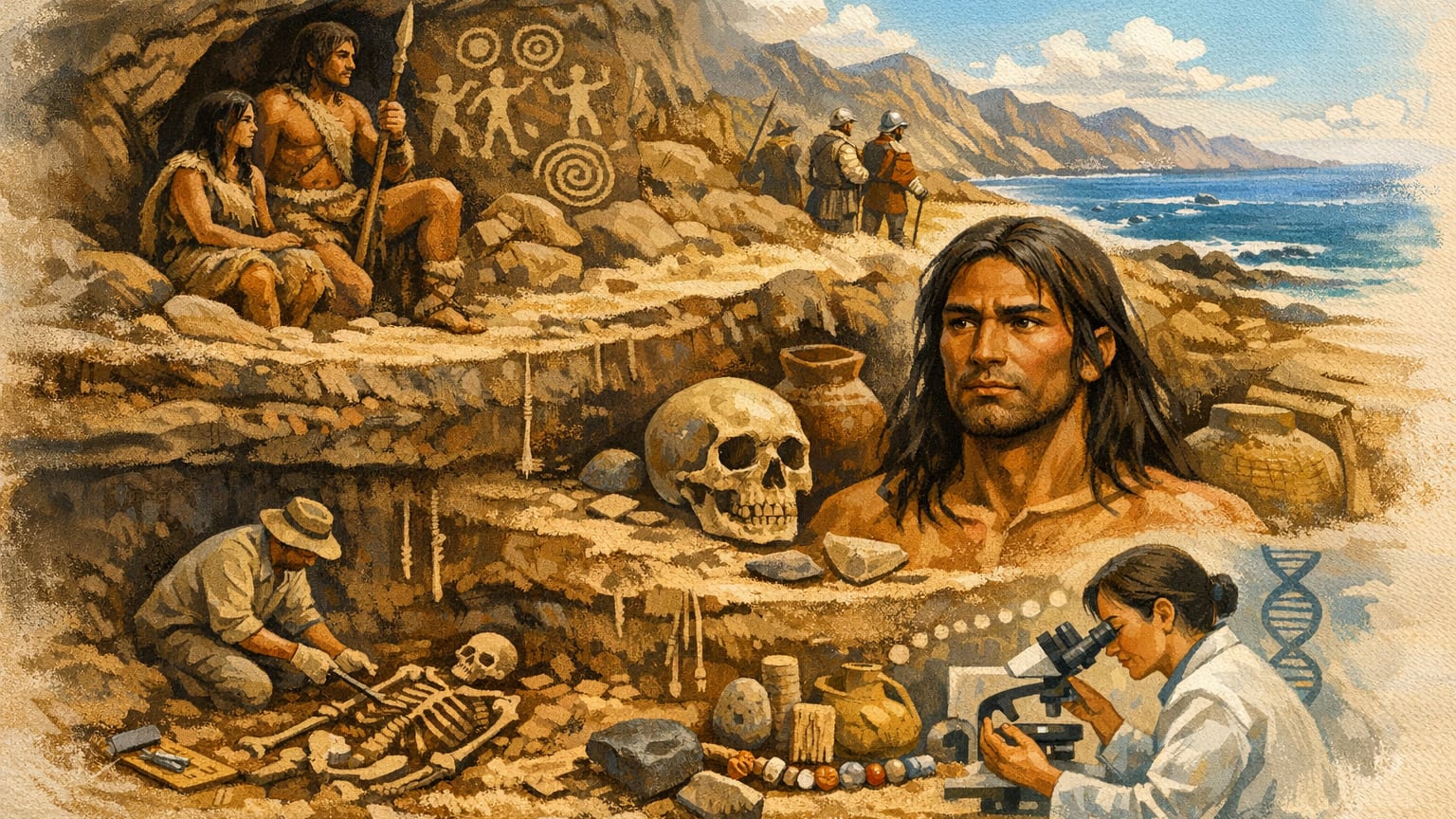
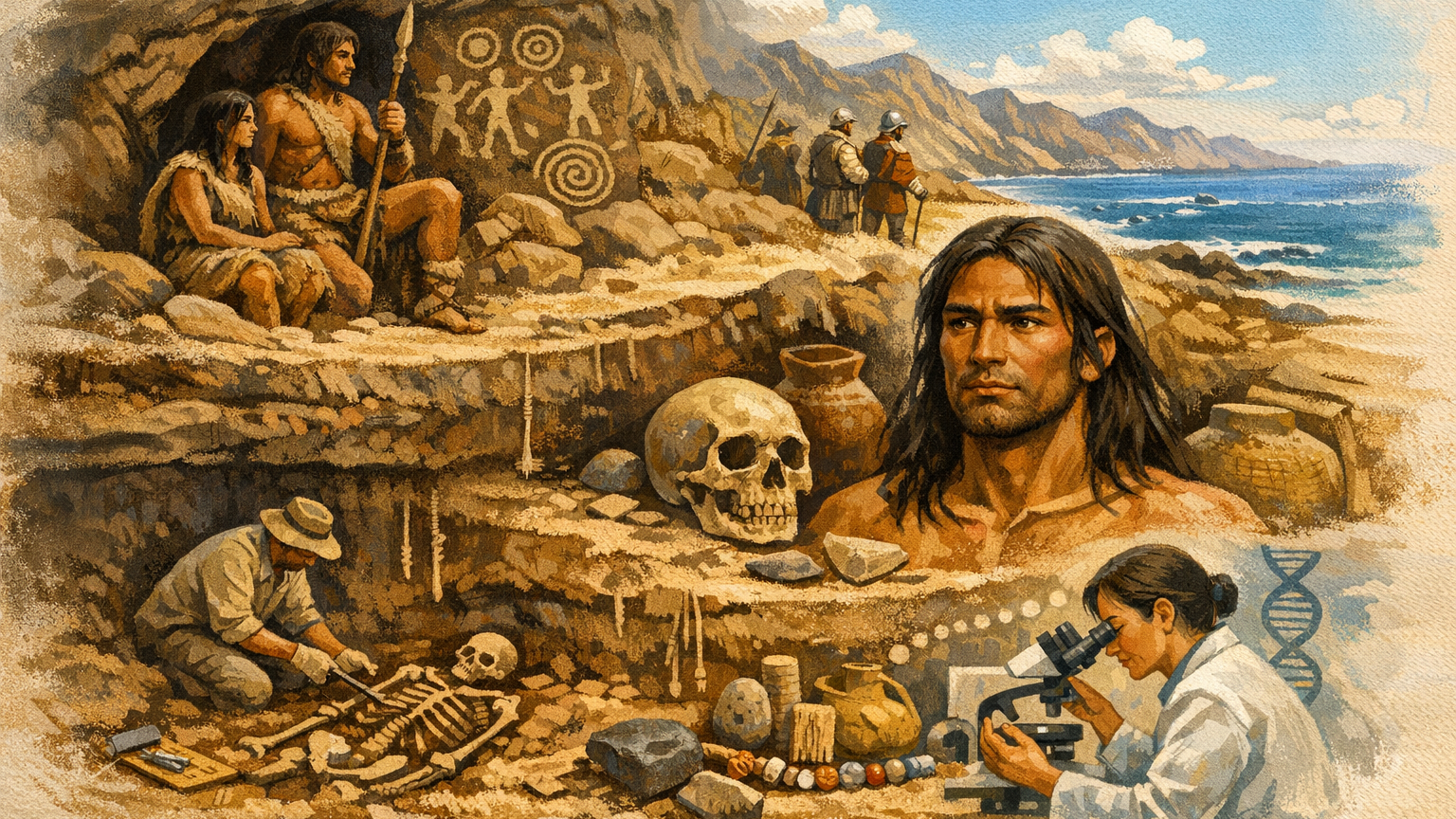
The Guanches, the pre-Hispanic inhabitants of Tenerife, have long fascinated historians, chroniclers, and scientists. But what did they really look like? Over the centuries, their physical image has been shaped by a mix of myth, observation, and scientific inquiry.
From Chronicles to Science: Shifting Perspectives
The earliest descriptions come from conquest-era chronicles (15th–17th centuries). Le Canarien described Tenerife’s people as “short in stature and very brave,” while Alonso de Palencia claimed they were “tall men.” Contradictions abound: Torriani and Espinosa spoke of giants up to fourteen feet tall (almost four meters), whereas Abreu Galindo simply called them “of medium height”[1].
Chroniclers also commented on their physical strength and courage. Espinosa noted differences between northern Guanches (fair-skinned and blond) and those from the south (darker-skinned), attributing these traits to both genetics and sun exposure. Viera y Clavijo, in the 18th century, emphasized that the Guanches “were neither black nor Indian,” a point that fueled debates about their status after the conquest[1].
The Rise of Physical Anthropology
In the 19th century, the emergence of physical anthropology brought a scientific approach to the study of Guanche remains. Sabin Berthelot was a pioneer, analyzing skulls and establishing typologies: Guanche, Canarian, Arab-Bedouin, and Berber. He observed that aboriginal traits persisted in the modern population, especially in isolated areas. Berthelot described the Guanche as having tanned skin, prominent foreheads, large eyes, thick hair (ranging from black to reddish), straight noses, thick lips, robust bodies, and medium to tall stature depending on the island[1].
Later researchers like René Verneau, Félix von Luschan, and E. A. Hooton expanded on these studies, using cranial measurements to classify types as dolichocephalic (long-headed), mesocephalic, or brachycephalic, and linking these to North African, Semitic, or Berber origins. Modern osteometric studies confirm significant physical diversity both between and within islands, with variations in height, build, and pigmentation[1].
Myths vs. Reality
The Guanche image has swung between the myth of the “blond giant” and that of the “primitive savage,” with romantic notions of nobility and racial purity in between. However, current bioanthropological research, based on skeletal and mummified remains, shows that the Guanches were not fundamentally different from other North African populations of their era. Their diversity was shaped by multiple migration waves and adaptation to the insular environment[1].
Thus, the physical image of the Guanche reflects both the evolution of scientific knowledge and the myths and biases of each era. Today, we understand the Guanches as a diverse people, adapted to their environment, whose true appearance can only be revealed through rigorous study of their remains and historical context.