

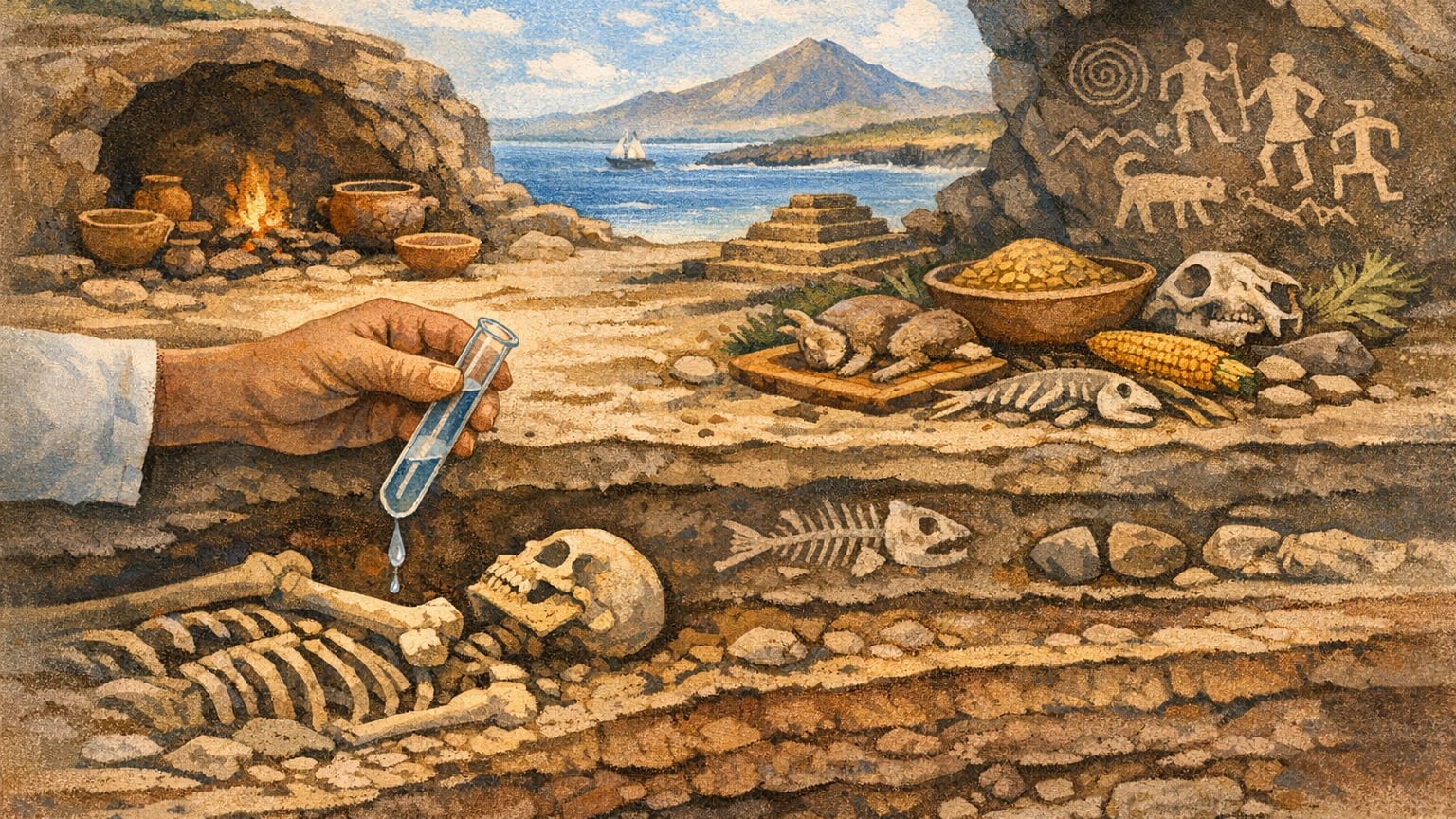
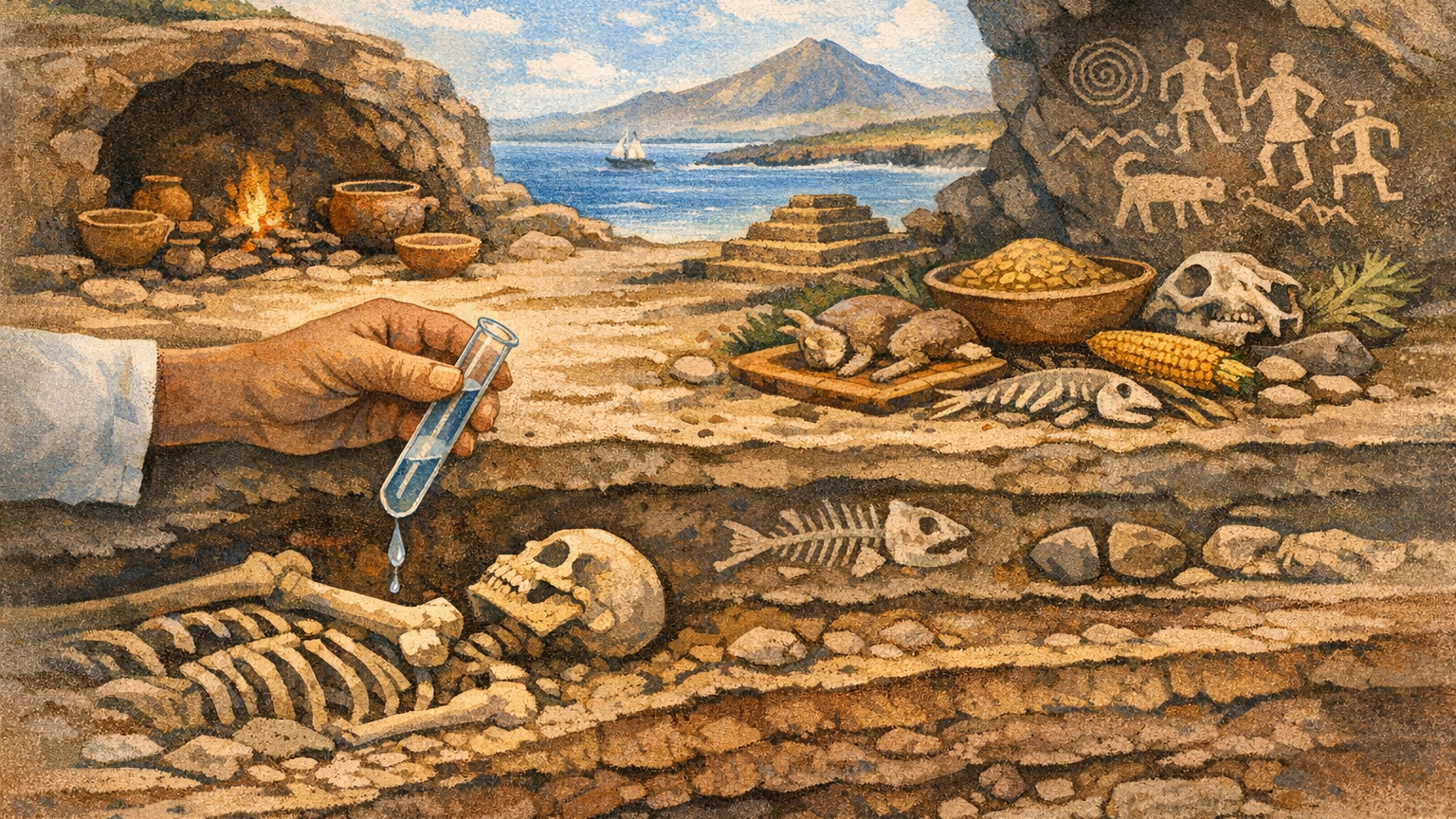
How can we know what people ate thousands of years ago in the Canary Islands or elsewhere? Beyond the study of plant and animal remains at archaeological sites, modern archaeology uses chemical techniques to reconstruct the diets of ancient populations from their bones. This approach, known as chemical reconstruction of diets, has transformed our understanding of how people adapted to their environments.[1]
Trace Elements: Strontium and Calcium
One widely used method analyzes the ratio of strontium (Sr) to calcium (Ca) in bones. Plants absorb these elements from the soil, and animals that eat the plants incorporate them into their skeletons. Humans, by consuming both meat and plants, reflect these proportions in their bones. A diet high in vegetables results in a higher Sr/Ca ratio, while a meat-heavy diet lowers it. By comparing human and animal bones from the same site, researchers can estimate the relative importance of meat and plants in ancient diets.[1]
However, this method has limitations: shellfish can alter strontium values, and post-burial chemical processes (diagenesis) may change the original bone composition.
Stable Isotopes: Carbon and Nitrogen
Another key technique studies stable isotopes of carbon (13C/12C) and nitrogen (15N/14N) in bone collagen. Different plants use different metabolic pathways (C3 and C4), which is reflected in their carbon isotope ratios. For example, maize (a C4 plant) leaves a distinct signature compared to traditional cereals (C3). Thus, delta 13C values in human bones can reveal when and how much maize entered a population’s diet.[1]
Nitrogen isotopes help distinguish between terrestrial and marine-based diets, as marine foods typically have much higher delta 15N values. This allows researchers to determine if coastal populations relied mainly on fishing and shellfish.
Applications and Examples
These techniques have been applied to pre-Hispanic populations on the northern coast of Chile, distinguishing between mariners, herders, and colonists based on their isotope and trace element values. Mariners, for example, showed extremely high delta 15N values, indicating a diet almost exclusively of fish and shellfish, while herders and colonists displayed more varied, mixed diets.[1]
Challenges and Future Directions
While chemical reconstruction of diets has opened a fascinating window into the past, researchers caution that diagenesis and local food analysis must be carefully controlled to interpret results accurately. In the Canary Islands, these techniques promise to shed new light on how ancient inhabitants adapted to their insular environment, shaping their diets and cultures.[1]