

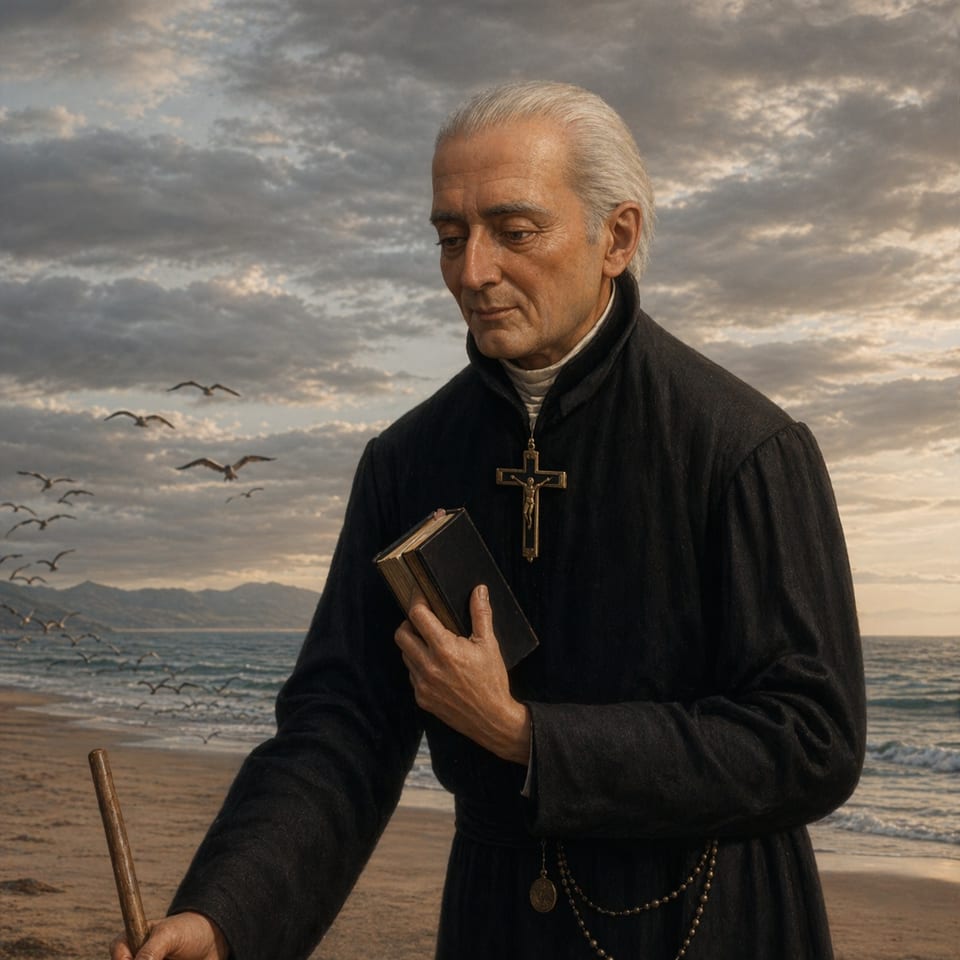
Conquista Religion 16th Century Saint and missionary
Jesuit missionary and saint
Jesuit missionary born in San Cristóbal de La Laguna, co-founder of São Paulo and Rio de Janeiro. Canonised in 2014 as Saint José de Anchieta.
Jesuit missionary and saint · 1534–1597
Jesuit missionary and saint
Jesuit missionary born in San Cristóbal de La Laguna, co-founder of São Paulo and Rio de Janeiro. Canonised in 2014 as Saint José de Anchieta.
José de Anchieta was born on 19 March 1534 in San Cristóbal de La Laguna, Tenerife, into a noble family of Basque origin. At nineteen he left to study at the Colégio das Artes in Coimbra (Portugal), where he joined the Society of Jesus. In 1553 he sailed to Brazil as a missionary. He arrived at the captaincy of São Vicente at barely nineteen years old and with the fragile health that would accompany him all his life.
In Brazil, Anchieta mastered the Tupi language so thoroughly that he composed in it the first dictionary and grammar of that language, as well as poems, plays and catechisms. In 1554 he participated in the founding of the college of São Paulo de Piratininga, the seed of the present-day city of São Paulo. Years later he helped found Rio de Janeiro (1565). He was appointed Provincial of Brazil (1577–1587), a post from which he promoted evangelisation and the defence of indigenous people against the abuses of settlers.
He was beatified by John Paul II in 1980 and canonised by Pope Francis on 3 April 2014. He is venerated as the 'Apostle of Brazil' by both the Church and the Brazilian State, which declared him the country's patron. The Tenerife native who spoke Tupi and Latin, who wrote poems and founded cities, is one of the most universal sons of the Canary Islands.
Missionary and saint
1626 - 1667
Meet figures
Privateer and merchant
1678 - 1747
Meet figures
Enlightenment historian and naturalist
1731 - 1813
Meet figures
Neoclassical poet and fabulist
1750 - 1791
Meet figures