

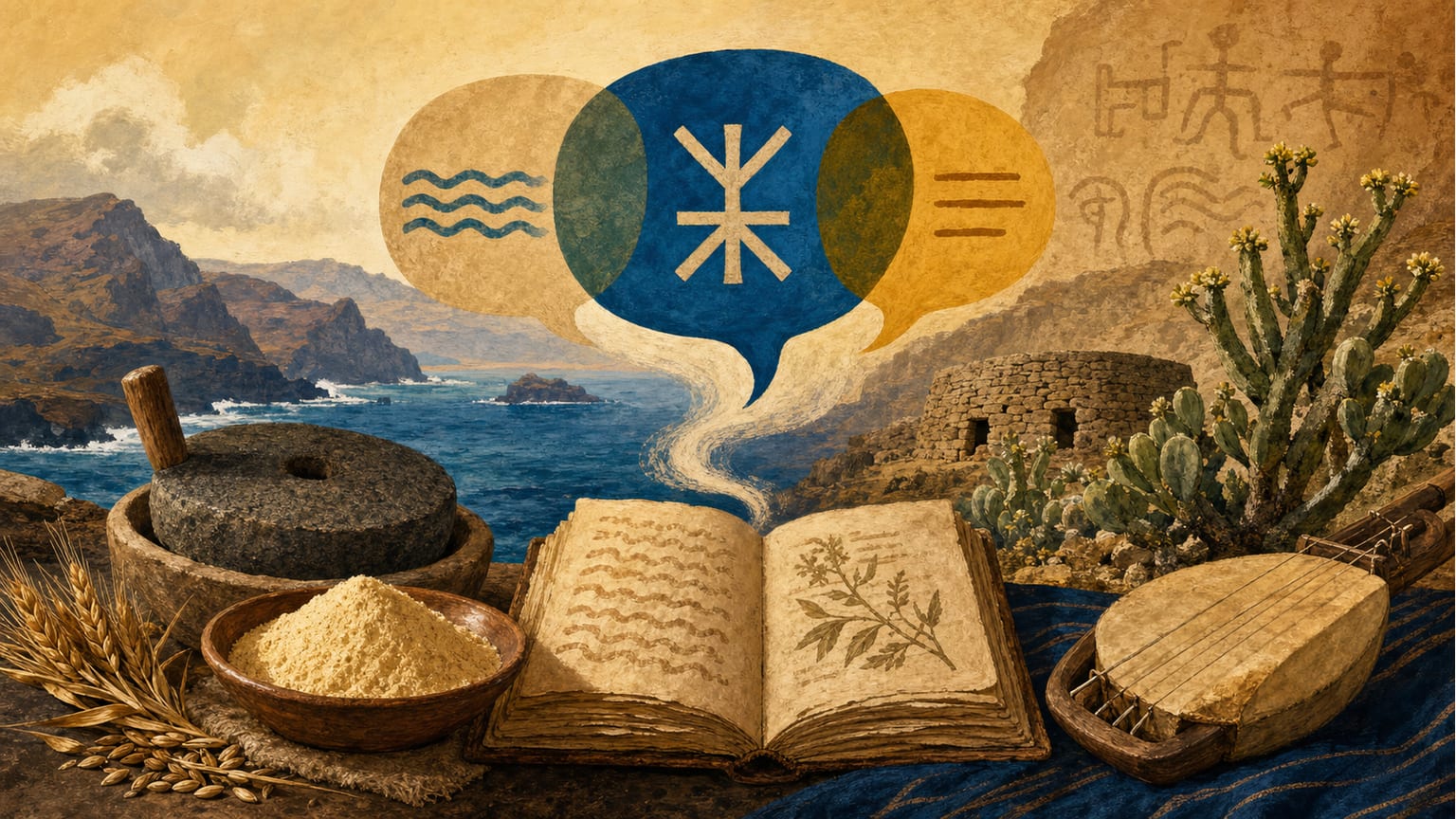
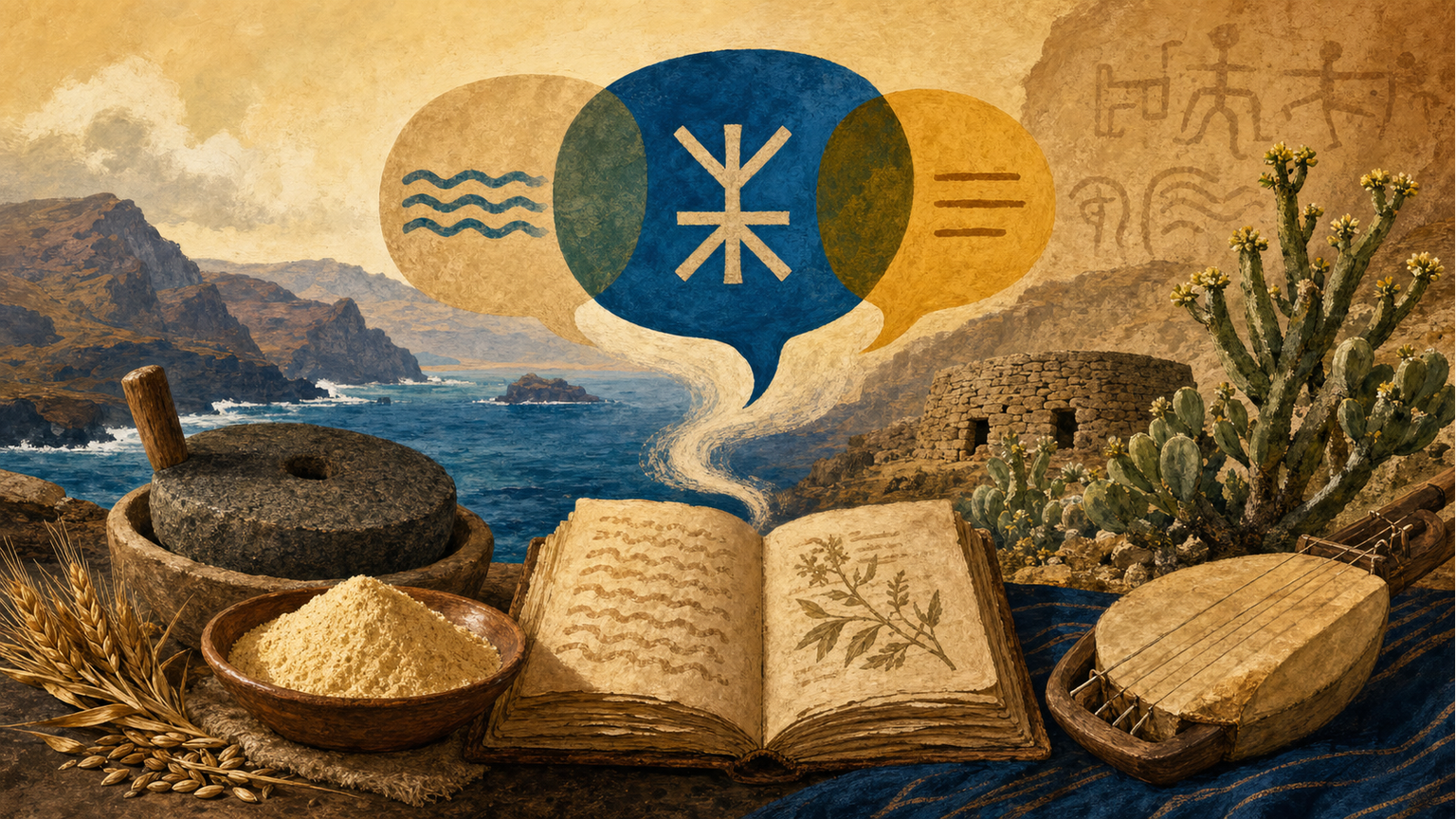
The Spanish spoken in the Canary Islands is a linguistic tapestry woven from centuries of cultural encounters. Among its most intriguing threads are words inherited from the Amazigh (Berber) peoples, the archipelago’s original inhabitants. Everyday terms such as gofio, tabaiba, and tenique are living relics of this ancient influence[1].
Gofio: A Staple with Ancient Roots
Gofio is perhaps the most iconic Amazigh-derived word in Canarian Spanish. Referring to roasted cereal flour, it has been a dietary staple since pre-Hispanic times. The word comes from the Amazigh gu±fu–w, meaning ‘flour’. Over centuries, the term underwent phonetic changes as it was absorbed into local Spanish, but its Amazigh root remains clear. Historical chronicles frequently mention gofio, highlighting its central role in the diet of the ancient Canarians[1].
Tabaiba: The Plant with a Name
Another Amazigh inheritance is tabaiba, the name for several species of euphorbia plants common across the islands. The term derives from taba–ba, used in Amazigh for similar plants. Tabaiba is not just a word; it is part of the islands’ traditional medicine and landscape, with its sap historically used for various purposes[1].
Tenique: The Hearthstone
Tenique refers to each of the three stones forming the traditional Canarian hearth, and by extension, any hard, compact stone. Its etymology traces back to the Amazigh root tenik, which in several dialects refers to the hearthstone. The persistence of this term highlights the continuity of daily practices and objects from pre-Hispanic times to today[1].
A Living Heritage
These examples illustrate the rich legacy of Amazigh words in Canarian Spanish. While many such terms are now mostly found in rural areas or place names, their study offers a window into the islands’ deep history and the enduring Amazigh influence on Canarian identity. Linguistic research, such as that by Ignacio Reyes García, shows how these words have evolved in meaning and form, adapting to new social and linguistic realities while preserving echoes of their ancient origins[1].
Thus, each time we say gofio, tabaiba, or tenique, we are speaking words that connect us to the Canary Islands’ earliest inhabitants and to a language that, though largely vanished, still lives on in everyday speech.