

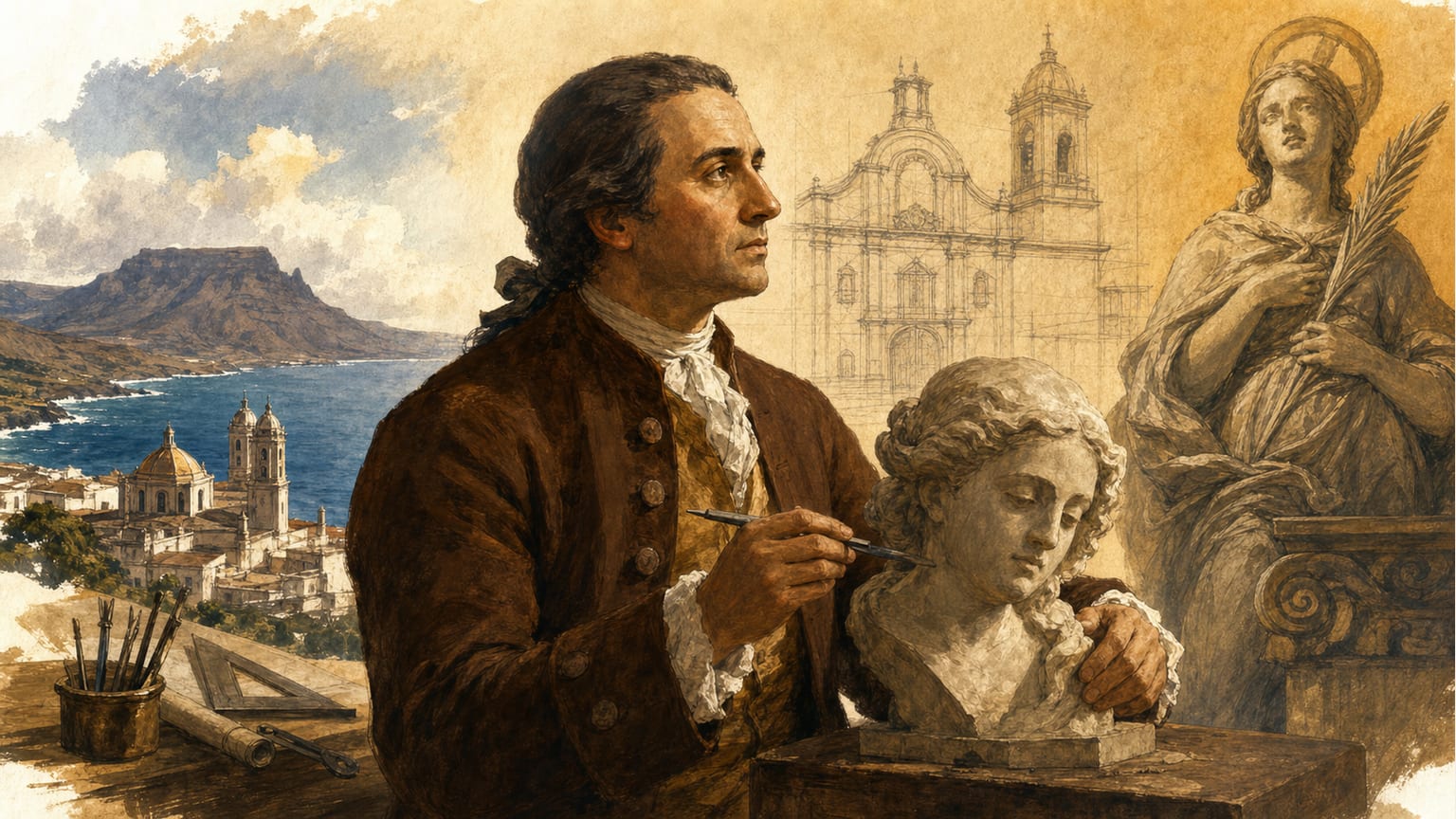
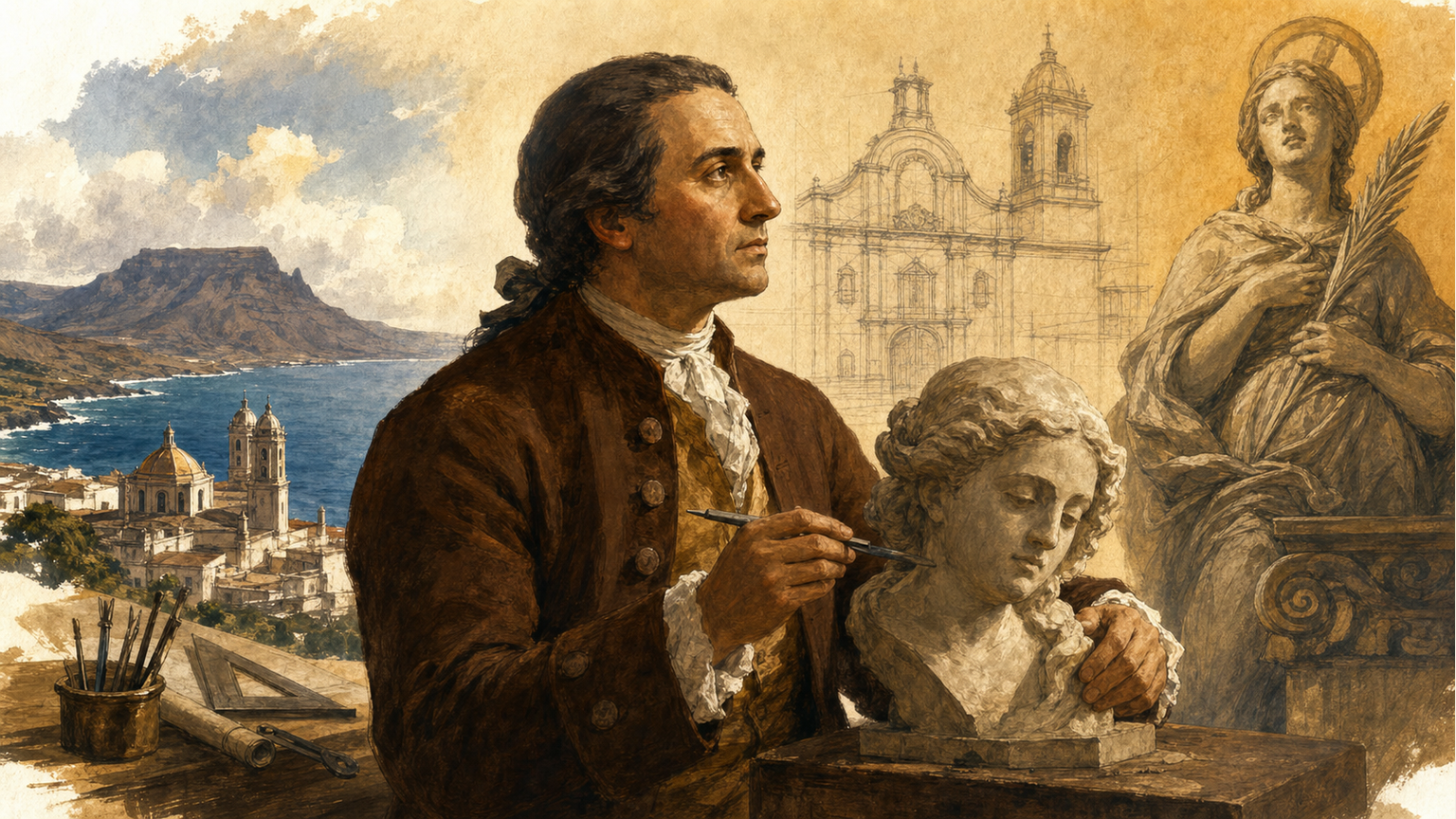
José Luján Pérez was born on May 9, 1756, in the town of Guía, Gran Canaria, to José Miguel Luján and Ana Pérez Sánchez. From an early age, he displayed a natural inclination for sculpture, working with clay and wood using only a knife as his tool. His persistent dedication to modeling figures, inspired by his surroundings, was evident despite family objections [1].
A family friend, Blas Sánchez Ochando, recognized his talent and encouraged him to move to Las Palmas to improve his drawing skills, predicting a bright future if he remained disciplined. In the island’s capital, Luján Pérez met Cristóbal Afonso, an art enthusiast who taught him the basics of drawing and chiseling. He also traveled to La Orotava to study the statue of Christ at the Column, then considered the finest example of statuary in the archipelago [1].
Luján Pérez was largely self-taught, supplementing his education with advice from local aficionados and by studying existing works in churches and convents. His artistic career benefited from the religious fervor of the time and the desire to enrich temples with new images. The construction of Las Palmas Cathedral and other churches on the island provided opportunities to showcase his talent and produce numerous sculptures [1].
Among his most notable works is the crucifix in the Chapter Hall of Las Palmas Cathedral, praised for its taste and inspiration. Also in the Cathedral, the Virgin of Sorrows in the oratory of Don Miguel Toledo is remarkable for the expression of pain and beauty in the face. The colossal statues of the apostles on the Cathedral’s dome, the Virgin of the Assumption in the Antigua chapel, and the Virgin of Carmen in San Agustín parish are also his creations [1].
Luján Pérez excelled not only in wood sculpture but also worked with marble and jasper, materials he sourced from local quarries. Examples include the bas-relief of Saint Anne on the Cathedral’s rear façade and several jasper models once held in the museum of the Sociedad de Amigos del País in Las Palmas [1].
In addition to his sculptural work, he directed and completed the Cathedral’s construction after the death of Diego Nicolás Eduardo, though he was less renowned as an architect. In his will, Luján Pérez donated one thousand pesos for a clock for the Guía parish and all his papers and models to the Las Palmas drawing academy, where he was a master and director. He died in December 1815 in his hometown, being the first to be buried in the Guía cemetery, a project he himself had promoted [1].